How 10x Genomics Visium Works: A Deep Dive into Spatial Transcriptomics

Gentaur
03 Feb 2025
Spatial transcriptomics is transforming gene expression analysis by preserving tissue architecture. 10x Genomics Visium enables high-resolution mapping of transcriptomic data using spatially barcoded slides and next-generation sequencing (NGS). This blog explores its workflow, key features, and applications in cancer research, neuroscience, and precision medicine, highlighting its impact on biomedical discoveries.
Introduction
What is 10x Genomics Visium?
10x Genomics Visium is a spatial transcriptomics technology that maps gene expression across tissue sections using barcoded spots and sequencing, allowing researchers to see where genes are active inside tissues.
How Visium Works
1. Tissue is placed on a barcoded slide
- Slides contain thousands of spots with unique barcodes
- Each spot captures RNA from nearby cells (≈1–10 cells)
2. RNA is captured in place (spatial context)
- Tissue is permeabilized → RNA released
- RNA binds to spatially barcoded probes
3. RNA → cDNA → sequencing
- Captured RNA is converted into cDNA
- Sequenced using NGS
- Each read keeps its spatial barcode
4. Data is mapped back to tissue
- Combine:
- Gene expression data
- Tissue image
- Result: map of gene activity across the tissue
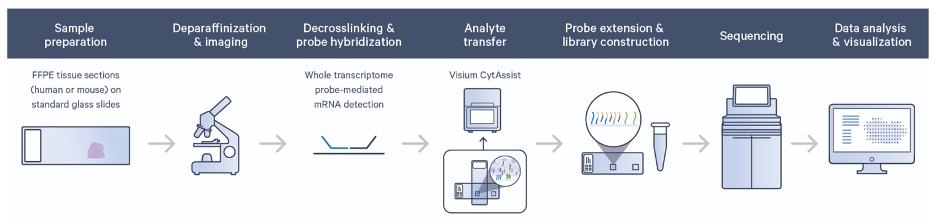
Expert Insight
Successful spatial transcriptomics experiments depend not only on sequencing quality, but also on tissue preservation, RNA integrity, imaging optimization, and computational analysis. Small variations in sample preparation may significantly impact spatial resolution and downstream biological interpretation.
The field of spatial transcriptomics has significantly advanced our ability to investigate gene expression while maintaining the spatial organization of cells within tissues. This breakthrough has opened new frontiers in biomedical research, allowing scientists to study gene activity within its native microenvironment rather than in isolation.
Among the most cutting-edge technologies driving this revolution is 10x Genomics Visium, a powerful platform that enables high-resolution mapping of transcriptomic landscapes across tissue sections. By seamlessly integrating next-generation sequencing (NGS) with spatially barcoded capture slides, Visium provides an unprecedented level of detail, allowing researchers to analyze gene expression patterns in their precise anatomical context.
This capability is invaluable for studying complex biological processes, such as tumor microenvironments, neural circuits, and developmental biology, where cellular interactions and spatial organization play a fundamental role. Visium not only facilitates a deeper understanding of how genes function within tissues but also aids in identifying biomarkers and therapeutic targets with potential clinical applications.
In this comprehensive exploration, we will delve into the core principles of 10x Genomics Visium, breaking down its workflow, the underlying technology that powers it, and the transformative applications it brings to modern biomedical research.
Understanding 10x Genomics Visium
10x Genomics Visium is a spatial transcriptomics platform designed to analyze mRNA expression while maintaining the spatial organization of tissue samples. It works by capturing mRNA from a tissue section and linking each transcript to its original spatial location, enabling the creation of spatially resolved transcriptomic maps.
Step-by-Step Workflow
1-Tissue Preparation and Fixation
- Fresh frozen or FFPE (formalin-fixed, paraffin-embedded) tissue sections are mounted onto Visium Spatial Gene Expression slides, which contain thousands of spatially barcoded oligonucleotide probes.
- Tissue integrity is preserved using fixation and permeabilization steps.
2-Staining and Imaging
- Tissue sections are stained (typically with H&E staining) to provide morphological context.
- High-resolution imaging is performed before transcriptomic analysis to allow correlation between gene expression and tissue structure.
3-mRNA Capture and Reverse Transcription
- The slide contains spatially barcoded oligonucleotides in an array of defined spots (~55µm in diameter).
- Permeabilization enables mRNA release, which binds to the barcode-linked probes.
- Reverse transcription occurs, generating complementary DNA (cDNA) while incorporating spatial barcodes.
4-Library Preparation and Sequencing
- The cDNA undergoes amplification and library preparation.
- The prepared libraries are sequenced using next-generation sequencing (NGS) platforms to identify gene expression patterns.
- Each transcript is tagged with a spatial barcode, allowing mapping back to specific locations in the tissue.
5-Data Analysis and Visualization
- The sequencing data is processed using 10x Genomics’ Space Ranger software, aligning reads to the reference genome and assigning them to spatial locations.
- The final results can be visualized using Loupe Browser, which overlays gene expression data onto tissue images, revealing spatially resolved transcriptomic patterns.
Spatial transcriptomics technologies such as Visium are transforming tissue analysis by enabling researchers to study gene expression within its native spatial context. This provides insights that are often difficult to obtain using conventional bulk RNA sequencing approaches.
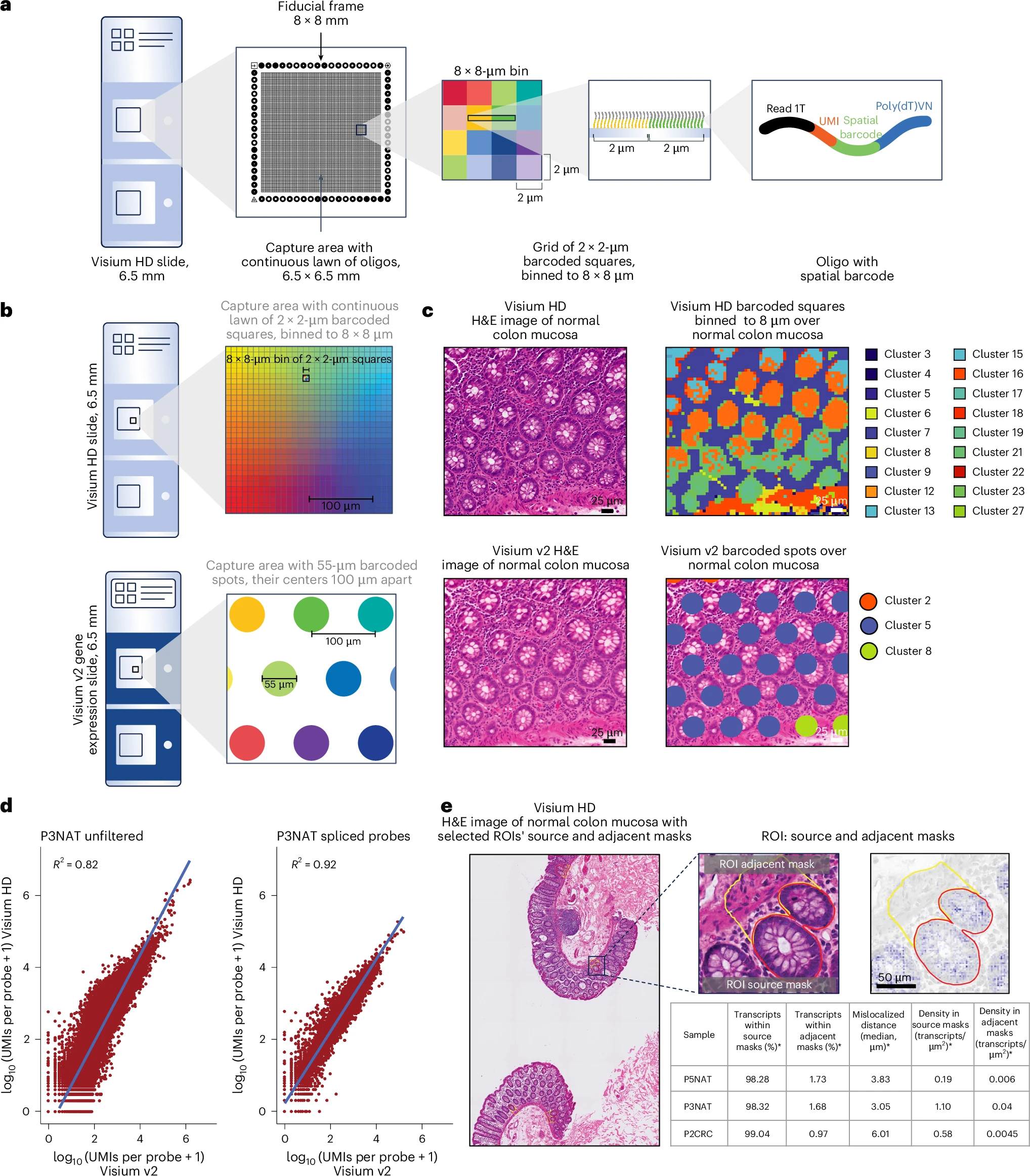
Data Analysis Pipeline in 10x Genomics Visium
After sequencing, Visium datasets are processed using specialized bioinformatics pipelines designed for spatial transcriptomics analysis. The workflow generally includes image alignment, barcode assignment, transcript quantification, clustering, and spatial visualization.
10x Genomics commonly provides analysis environments such as Space Ranger and Loupe Browser to help researchers explore spatial gene expression patterns directly within tissue architecture. These tools allow visualization of gene expression, clustering, and tissue-specific transcriptomic heterogeneity.
Data quality depends heavily on tissue preservation, RNA integrity, sequencing depth, and image alignment accuracy. Proper computational analysis is therefore essential for reliable biological interpretation.
Core Advantages of 10x Genomics Visium
-High Spatial Resolution: The Visium slides contain thousands of barcoded spots, each covering an area of 50-100 cells, preserving spatial context.
-Compatibility with Morphological Imaging: Enables integration with histological stains (H&E) or immunofluorescence for direct tissue visualization.
-Broad Tissue Compatibility: Works with both fresh frozen and FFPE tissue sections, making it suitable for archival samples.
-Comprehensive Transcriptome Analysis: Detects thousands of genes in a single experiment, providing deep insights into tissue heterogeneity.
Applications of 10x Genomics Visium in Research
- Cancer Research: Identifies tumor microenvironment interactions, characterizing heterogeneity in tumors.
- Neuroscience : Maps gene expression in brain tissues to study neurodevelopment and neurodegenerative diseases.
- Developmental Biology : Tracks gene expression across different tissue layers to understand organ development.
- Immunology : Examines immune cell localization and response in tissues.
- Regenerative Medicine : Investigates cellular dynamics in tissue repair and regeneration.
10x Genomics Visium has transformed spatial transcriptomics by allowing researchers to explore the complex relationship between gene expression and tissue architecture. By integrating sequencing with spatial barcoding, it provides an unprecedented level of resolution for studying biological processes in health and disease. As technology advances, spatial transcriptomics is poised to become an essential tool in precision medicine, biomarker discovery, and fundamental biological research.
Visium vs Other Technologies
Visium vs Other Spatial Transcriptomics Technologies
Several spatial transcriptomics platforms are currently available, each offering different levels of resolution, throughput, and workflow complexity.
10x Genomics Visium is widely recognized for its balance between scalability, tissue coverage, and ease of implementation. Other technologies, such as Xenium, MERFISH, and Slide-seq, may provide higher spatial resolution but often involve more complex workflows and computational requirements.
The choice of technology depends on experimental objectives, tissue complexity, required spatial resolution, and downstream analysis strategy.
Limitations of 10x Genomics Visium
Although Visium is a powerful spatial transcriptomics platform, several limitations should be considered during experimental design.
The technology relies on spot-based spatial capture rather than true single-cell resolution. As a result, each capture spot may contain transcripts originating from multiple neighboring cells. RNA quality and tissue preparation also strongly influence data quality and reproducibility.
In addition, spatial transcriptomics experiments may require substantial sequencing depth and advanced bioinformatics expertise for accurate interpretation and visualization.
Careful optimization of sample preparation, imaging conditions, and sequencing parameters is therefore essential for obtaining reliable results.
Spatial transcriptomics is increasingly used in oncology, neuroscience, immunology, developmental biology, and biomarker discovery. As spatial sequencing technologies continue to evolve, they are expected to play a central role in precision medicine and tissue-level molecular analysis.
Frequently Asked Questions
What is 10x Genomics Visium used for?
Visium is used to study spatial gene expression while preserving tissue architecture and cellular localization within biological samples.
Does Visium provide single-cell resolution?
Visium provides spatial transcriptomics at spot-level resolution rather than true single-cell resolution.
Which tissues can be analyzed with Visium?
Depending on workflow compatibility, Visium can support fresh frozen and FFPE tissue samples.
What software is commonly used for Visium analysis?
Space Ranger and Loupe Browser are commonly used for Visium data processing and spatial visualization.
MedicalBiology
Genetics
HumanBiology
Healthcare
Research
LifeSciences
Genomics
Published by Gentaur
03 Feb 2025
Recent Posts
14 Oct 2026Gentaur
cfDNA Extraction: Methods, Protocol, Sample Preparation, and Quality ControlIntroduction to cfDNA Extraction cfDNA extraction is the laboratory process used to isolate cell-free DNA (cfDNA) from biological samples, particularly blood plasma. This DNA consists of extracellular DNA fragments released into body fluids through c
08 Oct 2026Gentaur
Human Interleukin 6 ELISA Kit : Complete Guide to il 6 ELISA TestingInterleukin-6 (IL-6) is an important cytokine involved in immune regulation, inflammation, and cellular communication. Il 6 ELISA testing provides researchers with a practical method for detecting and quantifying human IL-6 in biological samples. A H
06 Oct 2026Gentaur
Automated Plasmid PurificationAutomated plasmid purification is becoming increasingly important in molecular biology laboratories that need to process larger numbers of samples while maintaining consistent DNA quality. Instead of relying entirely on manual centrifugation, pipetti
28 Sep 2026Gentaur
How to Interpret ELISA Results : A Practical Guide to OD Values, Standard Curves, Cutoffs and ControlsEnzyme-linked immunosorbent assay (ELISA) Enzyme-linked immunosorbent assay ( ELISA ) is widely used to detect and quantify proteins, antigens, antibodies, hormones, and other biological molecules. After completing an ELISA, the laboratory instrument