Immortalized Cells vs. Cancer Cells

Gentaur
14 Jan 2026
Immortalized cells and cancer cell lines are widely used in laboratory research.
Learn the key biological differences, advantages, and applications to choose the right in vitro cell model for reproducible and reliable experiments.
Introduction
Cell-based models are essential tools in modern life-science research. Among the most widely used are immortalized cell lines and cancer cell lines. While these two cell types share the ability to proliferate indefinitely in vitro, they are not biologically equivalent. Understanding their differences is critical for selecting the right model in cell biology, drug discovery, toxicology, molecular biology, and translational research.
What Are Immortalized Cells?
Immortalized cells are cells that have been modified to proliferate indefinitely while largely maintaining the characteristics of their tissue of origin.
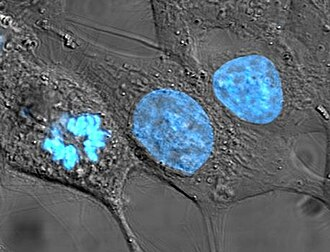
HeLa cells, an example of an immortalised cell line. DIC image, DNA stained with Hoechst 33258.
Key characteristics
- Derived from normal primary cells.
- Modified to bypass replicative senescence.
- Retain controlled growth behavior.
- Typically show stable morphology and function.
- Not tumor-derived.
Common immortalization methods
- Telomerase (hTERT) expression.
- SV40 large T antigen.
- HPV E6/E7 proteins.
- Conditional or reversible immortalization systems.
These approaches extend cell lifespan while aiming to preserve physiological relevance, making immortalized cells ideal for mechanistic and functional studies.
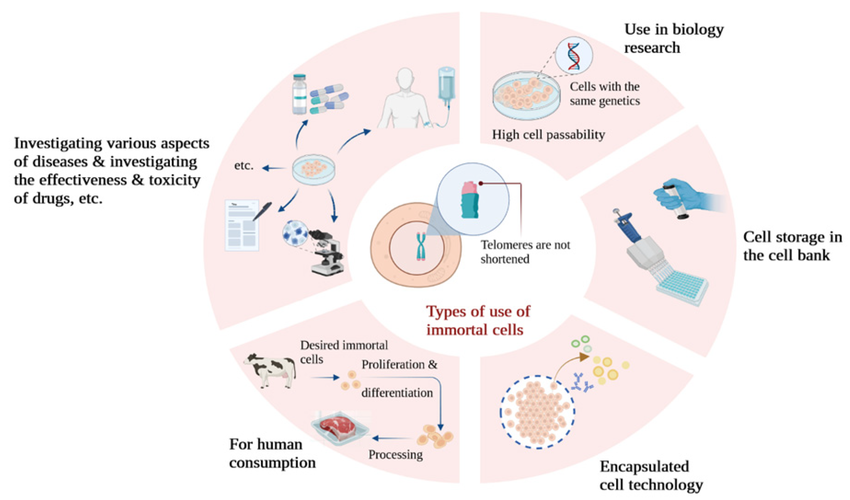
Schematic diagram of immortalization of cells.

Related products
HeLa Cell Slide
Catalog number: GTR10940598Luc-RFP-Hela Cells
Catalog number: GTR09893105EGFP-p65 HeLa Cells
Catalog number: GTR15504923Hela Cells Complete Medium
Catalog number: GTR10643922LoxP-STOP-loxP-EGFP HeLa Cells
Catalog number: GTR15504921LoxP-STOP-loxP-mCherry HeLa Cells
Catalog number: GTR15504922Hela Cell Specific Culture Medium
Catalog number: GTR15568260HeLa Cell Nuclear Extract
Catalog number: GTR05266531Hela Cell Line
Catalog number: GTR07361903Serum for HeLa Cell Culture
Catalog number: GTR15504541CRISPRa (SAM) HeLa Cell Line
Catalog number: GTR04857040What Are Cancer Cell Lines?
Cancer cell lines originate directly from tumor tissues. Their unlimited growth capacity arises naturally from oncogenic transformation, not from controlled laboratory immortalization.
Key characteristics
- Derived from malignant tumors
- Carry multiple genetic and chromosomal abnormalities
- Exhibit uncontrolled proliferation
- Often show metabolic reprogramming
- Highly heterogeneous between lines
Cancer cells are invaluable for studying tumor biology, but they may deviate significantly from normal cellular physiology.

Related products
Liver cancer
Catalog number: GTR01351529CA15-3 Cancer Antigen (Breast Cancer)
Catalog number: GTR11535567CA125 Cancer Antigen (Ovarian Cancer)
Catalog number: GTR11535603CA125 Cancer Antigen (Ovarian Cancer)
Catalog number: GTR11535581CA19-9 (Cancer, Cancer antigen 19-9, CA199) (AP)
Catalog number: GTR11274046Cancer Antigen 50
Catalog number: GTR09862546HeLa Human cervical cancer
Catalog number: GTR05207440CA19-9 (Cancer, Cancer antigen 19-9, CA199) (APC)
Catalog number: GTR11274569Human Cancer PrimaCell™15: Skin Cancer Cells
Catalog number: GTR05483290Cancer Antigen 125
Catalog number: GTR09872423Cancer Antigen 242
Catalog number: GTR09871635Cancer Antigen 15-3
Catalog number: GTR09866624Cancer Antigen 19-9
Catalog number: GTR11755077Human Colon Cancer
Catalog number: GTR02309350Immortalized Cells vs. Cancer Cells: Core Differences
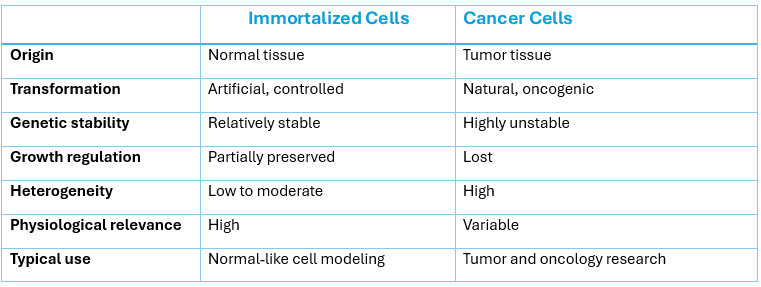
Genetic Stability and Experimental Reproducibility
One of the most important distinctions lies in genomic integrity :
-Immortalized cells generally maintain a more predictable genotype and phenotype over passages.
-Cancer cell lines often accumulate additional mutations, leading to batch-to-batch and passage-dependent variability.
For experiments requiring reproducibility, pathway analysis, and baseline cellular behavior, immortalized cells are often preferred.
Functional Behavior in the Laboratory
Immortalized cells are well suited for :
- Cell signaling studies.
- Gene regulation and reporter assays.
- Toxicity and metabolic screening.
- Protein expression and trafficking.
- Host–pathogen interaction models.
Cancer cells are ideal for :
- Oncogenic pathway research.
- Tumor metabolism studies.
- Cell cycle dysregulation analysis.
- Cancer-specific target validation.
Choosing the correct model improves data quality and biological relevance.
Advantages and Limitations
Immortalized cells
Advantages
- Closer to normal cell physiology
- Better consistency across experiments
- Easier interpretation of molecular mechanisms
Limitations
- Still modified systems
- May lack full tissue complexity
Cancer cells
Advantages
- Reflect advanced disease biology
- Strong proliferative capacity
- Extensive historical datasets available
Limitations
- Genetic drift
- Reduced physiological representativeness
- High variability between cell lines
Conclusion
Although immortalized cells and cancer cell lines both proliferate indefinitely, they serve distinct and complementary roles in laboratory research. Immortalized cells offer controlled, physiologically relevant systems, while cancer cells provide insight into malignant transformation and dysregulated growth.
Understanding these differences allows researchers to design robust experiments, interpret results accurately, and generate high-quality, reproducible data across life-science disciplines.
Immortalized Cell Lines
Cancer Cell Lines
Immortalized Cells VS Cancer Cells
Published by Gentaur
14 Jan 2026
Recent Posts
14 Oct 2026Gentaur
cfDNA Extraction: Methods, Protocol, Sample Preparation, and Quality ControlIntroduction to cfDNA Extraction cfDNA extraction is the laboratory process used to isolate cell-free DNA (cfDNA) from biological samples, particularly blood plasma. This DNA consists of extracellular DNA fragments released into body fluids through c
08 Oct 2026Gentaur
Human Interleukin 6 ELISA Kit : Complete Guide to il 6 ELISA TestingInterleukin-6 (IL-6) is an important cytokine involved in immune regulation, inflammation, and cellular communication. Il 6 ELISA testing provides researchers with a practical method for detecting and quantifying human IL-6 in biological samples. A H
06 Oct 2026Gentaur
Automated Plasmid PurificationAutomated plasmid purification is becoming increasingly important in molecular biology laboratories that need to process larger numbers of samples while maintaining consistent DNA quality. Instead of relying entirely on manual centrifugation, pipetti
28 Sep 2026Gentaur
How to Interpret ELISA Results : A Practical Guide to OD Values, Standard Curves, Cutoffs and ControlsEnzyme-linked immunosorbent assay (ELISA) Enzyme-linked immunosorbent assay ( ELISA ) is widely used to detect and quantify proteins, antigens, antibodies, hormones, and other biological molecules. After completing an ELISA, the laboratory instrument