Recombinant Proteins and Cytokines

Gentaur
05 May 2026
Discover how Recombinant Proteins and Cytokines in Cell Biology Research drive innovation in immunology, cancer studies, and drug development with high precision tools
Recombinant Proteins and Cytokines in Cell Biology Research
Introduction
Recombinant Proteins and Cytokines in Cell Biology Research play a fundamental role in understanding cellular mechanisms, signaling pathways, and disease progression. With advances in biotechnology, recombinant protein production has become more efficient, enabling researchers to study biological processes with high precision and reproducibility.
Today, Recombinant Proteins and Cytokines in Cell Biology Research are essential tools in areas such as immunology, cancer research, stem cell biology, and drug discovery. Their ability to mimic natural biological molecules allows scientists to control and analyze complex cellular interactions in vitro.
What Are Recombinant Proteins?
Recombinant proteins are artificially produced proteins generated using genetic engineering techniques. By inserting a gene of interest into an expression system (such as bacteria, yeast, or mammalian cells), scientists can produce large quantities of specific proteins.
Key Characteristics:
- High purity and consistency
- Scalable production
- Customizable modifications
- Functional similarity to native proteins
In Recombinant Proteins and Cytokines in Cell Biology Research, these proteins are widely used to replicate natural cellular environments.
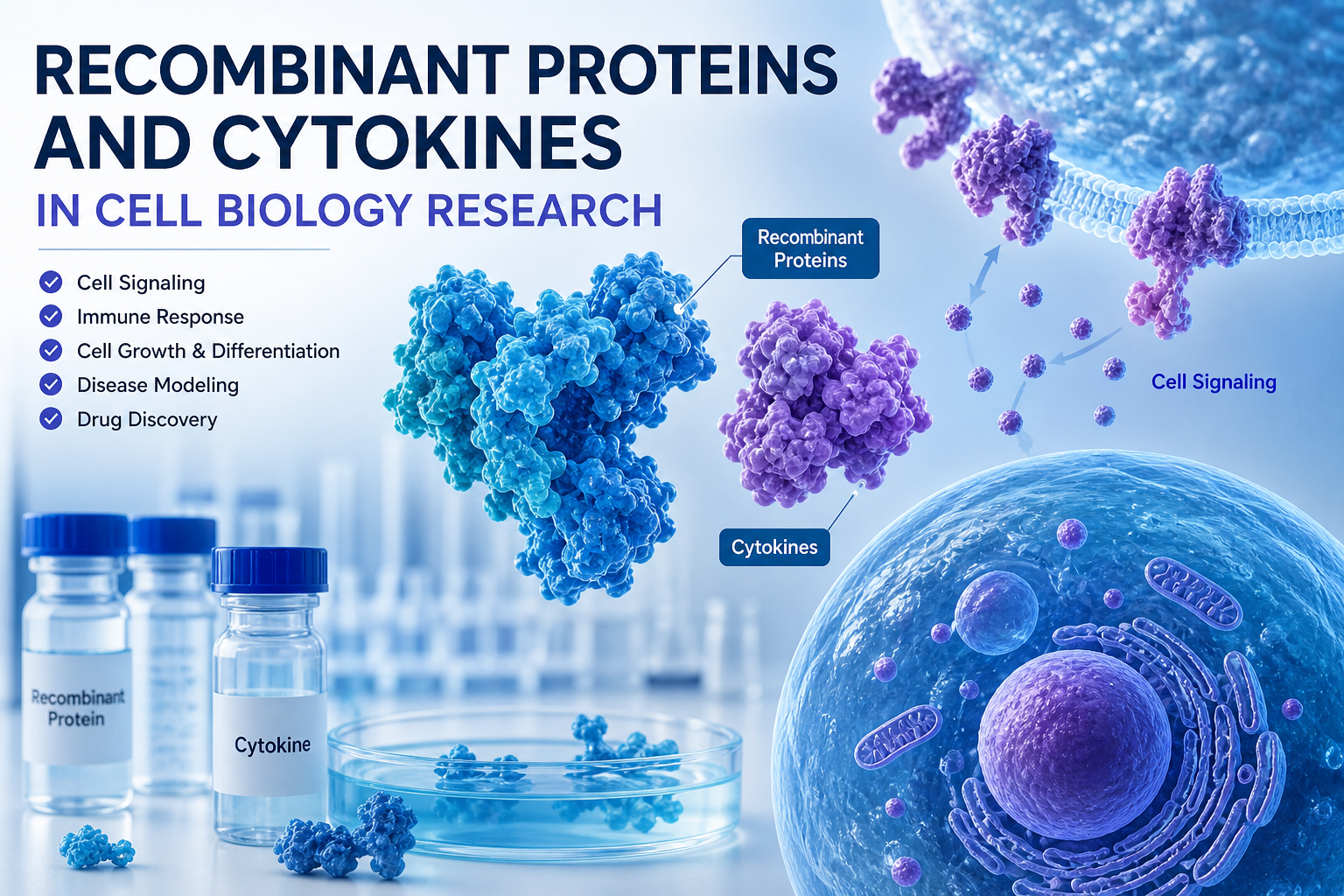
Understanding Cytokines in Cell Biology
Cytokines are small signaling proteins that regulate immunity, inflammation, and cell communication. They are critical components in Recombinant Proteins and Cytokines in Cell Biology Research because they influence:
- Cell proliferation
- Differentiation
- Apoptosis
- Immune responses
Common cytokines include interleukins (ILs), interferons (IFNs), and tumor necrosis factors (TNFs), all of which are frequently produced as recombinant proteins for laboratory use.
Importance of Recombinant Proteins and Cytokines in Cell Biology Research
1. Cell Signaling Studies
Recombinant Proteins and Cytokines in Cell Biology Research allow precise control of signaling pathways. Researchers can activate or inhibit specific pathways to study cellular responses under controlled conditions.
2. Disease Modeling
In cancer and autoimmune diseases, cytokines play a critical role. Using Recombinant Proteins and Cytokines in Cell Biology Research, scientists can recreate disease environments in vitro to better understand pathological mechanisms.
3. Drug Discovery and Development
Pharmaceutical companies rely heavily on Recombinant Proteins and Cytokines in Cell Biology Research to:
- Screen drug candidates
- Evaluate therapeutic targets
- Test drug efficacy and toxicity
4. Stem Cell Research
Cytokines regulate stem cell fate. In Recombinant Proteins and Cytokines in Cell Biology Research, they are used to control stem cell differentiation into specific cell types.
Types of Recombinant Proteins Used in Cell Biology
Growth Factors
- Stimulate cell growth and proliferation
- Examples: EGF, VEGF
Enzymes
- Catalyze biochemical reactions
- Used in metabolic studies
Antibodies
- Used for detection and targeting
- Essential in assays and diagnostics
Cytokines
- Regulate immune and cellular responses
- Central to Recombinant Proteins and Cytokines in Cell Biology Research
Expression Systems for Recombinant Proteins
The production system affects protein quality and functionality:
Bacterial Systems (E. coli)
- Fast and cost-effective
- Limited post-translational modifications
Yeast Systems
- Better protein folding
- Moderate scalability
Mammalian Systems
- Closest to native human proteins
- Ideal for Recombinant Proteins and Cytokines in Cell Biology Research
Applications in Modern Research
Immunology
Recombinant Proteins and Cytokines in Cell Biology Research are widely used to study immune cell activation, cytokine storms, and inflammatory responses.
Cancer Research
Tumor microenvironments are influenced by cytokines. Researchers use recombinant cytokines to analyze cancer progression and immune evasion.
Vaccine Development
Recombinant proteins serve as antigens, while cytokines act as adjuvants, making Recombinant Proteins and Cytokines in Cell Biology Research crucial in vaccine innovation.
Cell Culture Optimization
Adding recombinant cytokines improves:
- Cell viability
- Growth rates
- Experimental reproducibility
Advantages of Recombinant Proteins and Cytokines
- High reproducibility across experiments
- Reduced variability compared to natural sources
- Ethical alternative to animal-derived proteins
- Scalable for industrial applications
- High specificity in cellular assays
These benefits make Recombinant Proteins and Cytokines in Cell Biology Research indispensable in modern laboratories.
Challenges and Considerations
Despite their advantages, researchers must consider:
- Protein misfolding in some expression systems
- Stability and storage conditions
- Batch-to-batch variability
- Cost of high-quality recombinant cytokines
Optimizing these factors ensures reliable outcomes in Recombinant Proteins and Cytokines in Cell Biology Research.
Future Trends in Cell Biology Research
The future of Recombinant Proteins and Cytokines in Cell Biology Research is driven by innovation:
- Advanced protein engineering
- Synthetic biology approaches
- AI-driven protein design
- High-throughput screening technologies
These developments will further enhance the precision and applications of recombinant proteins in biological research.
Conclusion
Recombinant Proteins and Cytokines in Cell Biology Research are at the core of modern scientific discovery. Their versatility, reliability, and ability to replicate natural biological processes make them essential tools for understanding cellular function and developing new therapies.
As research continues to evolve, the importance of Recombinant Proteins and Cytokines in Cell Biology Research will only grow, driving breakthroughs in medicine, biotechnology, and life sciences.
Related products
Mouse Cytokines (cytokines) ELISA kit
Catalog number: GTR07110575Cytokine SCM-1 beta
Catalog number: GTR04680253Bovine Cytokines IL-8 (Cytokines IL-8) ELISA Kit
Catalog number: GTR07109233Cytokines
Recombinant Proteins
Published by Gentaur
05 May 2026
Recent Posts
14 Oct 2026Gentaur
cfDNA Extraction: Methods, Protocol, Sample Preparation, and Quality ControlIntroduction to cfDNA Extraction cfDNA extraction is the laboratory process used to isolate cell-free DNA (cfDNA) from biological samples, particularly blood plasma. This DNA consists of extracellular DNA fragments released into body fluids through c
08 Oct 2026Gentaur
Human Interleukin 6 ELISA Kit : Complete Guide to il 6 ELISA TestingInterleukin-6 (IL-6) is an important cytokine involved in immune regulation, inflammation, and cellular communication. Il 6 ELISA testing provides researchers with a practical method for detecting and quantifying human IL-6 in biological samples. A H
06 Oct 2026Gentaur
Automated Plasmid PurificationAutomated plasmid purification is becoming increasingly important in molecular biology laboratories that need to process larger numbers of samples while maintaining consistent DNA quality. Instead of relying entirely on manual centrifugation, pipetti
28 Sep 2026Gentaur
How to Interpret ELISA Results : A Practical Guide to OD Values, Standard Curves, Cutoffs and ControlsEnzyme-linked immunosorbent assay (ELISA) Enzyme-linked immunosorbent assay ( ELISA ) is widely used to detect and quantify proteins, antigens, antibodies, hormones, and other biological molecules. After completing an ELISA, the laboratory instrument