RT-PCR

Gentaur
21 May 2026
Revolutionizing Molecular Diagnostics
Discover the science behind RT-PCR, its steps, and real-time applications for research and clinical diagnostics.
Introduction to RT-PCR
Reverse Transcriptase Polymerase Chain Reaction (RT-PCR) is a critical tool in molecular biology that allows the detection and quantification of RNA sequences. It’s widely used in clinical diagnostics, research, and biotechnology to provide highly sensitive and accurate results. RT-PCR is instrumental in detecting viral infections, studying gene expression, and monitoring RNA-based therapeutics.

How RT-PCR Works?
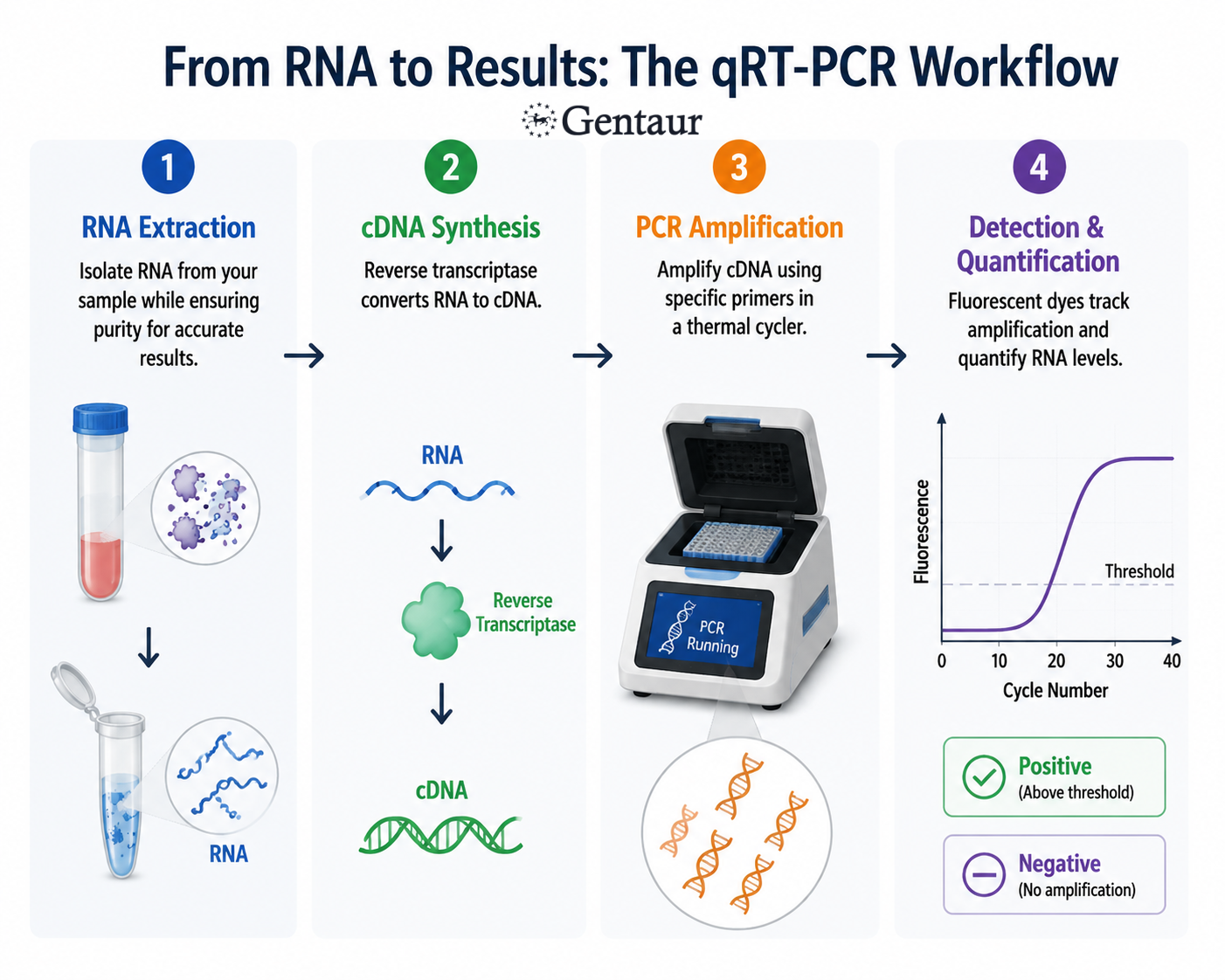
RT-PCR converts RNA into complementary DNA (cDNA) using reverse transcriptase. The cDNA is then amplified using PCR, creating millions of copies of the target sequence. Fluorescent markers enable real-time detection, allowing researchers to quantify gene expression precisely.
Key Steps:
1- RNA Extraction : Isolate RNA from your sample while ensuring purity for accurate results.
2- cDNA Synthesis : Reverse transcriptase converts RNA to cDNA.
3- PCR Amplification : Amplify cDNA using specific primers in a thermal cycler.
4- Detection & Quantification : Fluorescent dyes track amplification and quantify RNA levels.
Applications of RT-PCR
RT-PCR is versatile and widely used across life sciences :
- Clinical Diagnostics.
- Gene Expression Analysis: Measure RNA levels to study cellular signaling and gene regulation.
- Pharmaceutical Research: Monitor RNA-based therapies and target gene expression in dr ug development.

Expert Tips & FAQs
What is RT-PCR?
=> It’s a technique that converts RNA into DNA and amplifies it to detect and quantify gene expression.
How does RT-PCR work?
=> Through RNA extraction, reverse transcription to cDNA, PCR amplification, and real-time fluorescent detection.
What are RT-PCR steps?
=> The main steps include RNA extraction, cDNA synthesis, PCR amplification, and detection.
Why RT-PCR is Essential?
=> RT-PCR provides unmatched sensitivity and precision, making it the gold standard for RNA detection and quantification. Its real-time capabilities allow scientists to monitor reactions dynamically, saving time and improving accuracy in diagnostics and research.
RT-PCR
rt pcr steps
rt pcr test
reverse transcriptase
qPCR
DNA
Published by Gentaur
21 May 2026
Recent Posts
14 Oct 2026Gentaur
cfDNA Extraction: Methods, Protocol, Sample Preparation, and Quality ControlIntroduction to cfDNA Extraction cfDNA extraction is the laboratory process used to isolate cell-free DNA (cfDNA) from biological samples, particularly blood plasma. This DNA consists of extracellular DNA fragments released into body fluids through c
08 Oct 2026Gentaur
Human Interleukin 6 ELISA Kit : Complete Guide to il 6 ELISA TestingInterleukin-6 (IL-6) is an important cytokine involved in immune regulation, inflammation, and cellular communication. Il 6 ELISA testing provides researchers with a practical method for detecting and quantifying human IL-6 in biological samples. A H
06 Oct 2026Gentaur
Automated Plasmid PurificationAutomated plasmid purification is becoming increasingly important in molecular biology laboratories that need to process larger numbers of samples while maintaining consistent DNA quality. Instead of relying entirely on manual centrifugation, pipetti
28 Sep 2026Gentaur
How to Interpret ELISA Results : A Practical Guide to OD Values, Standard Curves, Cutoffs and ControlsEnzyme-linked immunosorbent assay (ELISA) Enzyme-linked immunosorbent assay ( ELISA ) is widely used to detect and quantify proteins, antigens, antibodies, hormones, and other biological molecules. After completing an ELISA, the laboratory instrument