Screw Cap, Microcentrifuge and Low-Retention Tubes for Laboratory Sample Handling

Gentaur
15 Jul 2026
Explore ABDOS screw-cap, microcentrifuge and low-retention tubes for sample preparation, centrifugation and storage. Compare sizes, closures, sterility and tube formats.
ABDOS Screw Cap and Microcentrifuge Tubes for Reliable Sample Preparation, Centrifugation and Storage
Laboratory tubes are central to almost every life-science workflow. They are used to collect samples, prepare reagents, perform centrifugation, store biological materials and transfer liquids between experimental stages.
However, not every tube provides the same level of sealing, sample recovery, temperature resistance or contamination control. Tube volume, material, closure mechanism, shape and surface characteristics can all influence laboratory performance.
The ABDOS products available through Gentaur include a broad selection of microcentrifuge tubes, screw-cap tubes and low-retention tubes in 0.5 mL, 1.5 mL and 2.0 mL formats. Available configurations include sterile and non-sterile products, clear and amber tubes, coloured caps, self-standing or conical bottoms, and printed or non-printed surfaces.
ABDOS laboratory tubes are polypropylene sample-handling consumables designed for routine centrifugation, molecular biology, reagent preparation, sample identification and short- or longer-term storage workflows.
Why does tube selection matter?
A laboratory tube is not simply a container. Its material and design can affect :
- Sample recovery
- Evaporation
- Leakage
- Centrifugation stability
- Temperature tolerance
- Contamination risk
- Sample identification
- Light exposure
- Ease of handling
- Compatibility with racks and automation
Surface adsorption is particularly relevant when working with low-concentration DNA, proteins, peptides or other valuable analytes. Independent studies have demonstrated that tube surface properties can influence protein and peptide recovery, and that low-binding performance may vary significantly among tube types and experimental conditions. Pubmed
DNA can also interact with polypropylene surfaces under certain chemical conditions, particularly when ionic strength is high. This means that tube selection, buffer composition and sample concentration should all be considered when optimizing sensitive nucleic-acid workflows. Pubmed
What are microcentrifuge tubes?
Microcentrifuge tubes are small laboratory tubes commonly used for preparing, mixing, centrifuging and storing microlitre- to millilitre-scale samples.
ABDOS microcentrifuge tubes are manufactured from medical-grade polypropylene and are available in 0.5 mL, 1.5 mL and 2.0 mL volumes. The manufacturer lists integral snap-cap closures, resistance to centrifugation up to 20,000 × g and a working temperature range from -80 °C to +121 °C.
Common applications include:
- DNA and RNA extraction
- PCR reagent preparation
- Protein sample preparation
- Enzyme reactions
- Buffer preparation
- Cell-pellet processing
- Sample aliquoting
- Short-term reagent storage
- High-speed microcentrifugation
ABDOS lists natural, coloured and amber microcentrifuge tube variants, as well as sterile bulk-packed and individually wrapped formats.
Related products
Micro Centrifuge Tubes, PP, 1.5 mL, DNase/RNase free - 500 un. - ABDOS
Catalog number: GTR15998675Micro Centrifuge Tubes, PP, 0.5 mL, DNase/RNase free - 1000 un. - ABDOS
Catalog number: GTR15998674Micro Centrifuge Tubes, PP, 2.0 mL, DNase/RNase free - 500 un. - ABDOS
Catalog number: GTR15998786Micro Centrifuge Tubes, PP, 2.0 mL, Amber, DNase/RNase free - 500 un. - ABDOS
Catalog number: GTR15998687Micro Centrifuge Tubes, PP, 0.5 mL, Amber, DNase/RNase free - 1000 un. - ABDOS
Catalog number: GTR15999341Micro Centrifuge Tube Rack, PP, With Cover, 96 Place, Green - 6 un. - ABDOS
Catalog number: GTR16000155Micro Centrifuge Tube Rack, PP, With Cover, 80 Place, Blue - 6 un. - ABDOS
Catalog number: GTR16000161Micro Centrifuge Tube Rack, PP, With Cover, 96 Place, Yellow - 6 un. - ABDOS
Catalog number: GTR16000156Micro Centrifuge Tube Rack, PP, With Cover, 96 Place, Blue - 6 un. - ABDOS
Catalog number: GTR16000157Micro Centrifuge Tube Rack, PP, With Cover, 80 Place, Green - 6 un. - ABDOS
Catalog number: GTR16000159What are screw-cap tubes?
Screw-cap tubes use a threaded cap instead of an integral snap closure. The ABDOS screw-cap range uses an EPDM O-ring intended to provide a secure seal between the cap and the tube.
According to the manufacturer’s screw-cap tube documentation, the products are manufactured from virgin polypropylene and are offered in 0.5 mL, 1.5 mL and 2.0 mL formats. The range includes clear, amber and colour-coded options, together with self-standing and conical designs.
Screw-cap tubes are especially useful when stronger closure security is needed for :
- Sample transportation
- Repeated handling
- Valuable biological samples
- Volatile reagents
- Freezing and thawing workflows
- High-speed centrifugation
- Storage where evaporation must be minimized
- Applications requiring colour-coded identification
ABDOS lists a centrifugal resistance of up to 20,000 × g for its screw-cap range. Its technical leaflet specifies a temperature range of −80 °C to +95 °C and describes short-term compatibility with dry ice, wet ice and vapour-phase liquid nitrogen conditions.
Screw cap versus snap cap tubes
The correct closure depends on the application, required handling speed and desired level of sealing.

Related products
Rack for 0.5/1.5/2.0 ml for Screw Cap Tubes, 20 Places, 1 un - ABDOS
Catalog number: GTR15999317Printed, non-assembled Screw Cap Tube, Conical, PP, 1.5 mL, with EPDM ring Cap, Blue - 1000 un, DNase/RNase free - ABDOS
Catalog number: GTR15998760Printed, assembled Screw Cap Tube, Self-Standing, PP, 1.5 mL, with EPDM ring Cap, 1000 un, DNase/RNase free - ABDOS
Catalog number: GTR15998973Printed, assembled Screw Cap Tube, Conical, PP, 1.5 mL, Amber, with EPDM ring Cap, 1000 un, DNase/RNase free - ABDOS
Catalog number: GTR15998998Printed, assembled Screw Cap Tube, Conical, PP, 1.5 mL, with EPDM ring Cap, Yellow - 1000 un, DNase/RNase free - ABDOS
Catalog number: GTR15999003Printed, assembled Screw Cap Tube, Conical, PP, 2.0 mL, with EPDM ring Cap, Red - 1000 un, DNase/RNase free - ABDOS
Catalog number: GTR15999047Printed, assembled Screw Cap Tube, Conical, PP, 2.0 mL, with EPDM ring Cap, Green - 1000 un, DNase/RNase free - ABDOS
Catalog number: GTR15999050What is the purpose of an EPDM O-ring?
EPDM is an elastomer used as the sealing ring inside many laboratory screw caps. When the cap is tightened, the ring is compressed between the cap and tube opening.
The O-ring helps :
- Reduce liquid leakage
- Limit evaporation
- Maintain closure during handling
- Protect samples during transport
- Improve sealing through temperature changes
- Reduce direct exposure of the sample to the external environment
The ABDOS screw-cap tube range uses a black EPDM O-ring, with the ring design and material selected to support sealing and temperature performance.

Related products
Printed, non-assembled Screw Cap Tube, Conical, PP, 1.5 mL, with EPDM ring Cap, Blue - 1000 un, DNase/RNase free - ABDOS
Catalog number: GTR15998760Printed, assembled Screw Cap Tube, Self-Standing, PP, 1.5 mL, with EPDM ring Cap, 1000 un, DNase/RNase free - ABDOS
Catalog number: GTR15998973Printed, assembled Screw Cap Tube, Conical, PP, 1.5 mL, Amber, with EPDM ring Cap, 1000 un, DNase/RNase free - ABDOS
Catalog number: GTR15998998Printed, assembled Screw Cap Tube, Conical, PP, 1.5 mL, with EPDM ring Cap, Yellow - 1000 un, DNase/RNase free - ABDOS
Catalog number: GTR15999003Printed, assembled Screw Cap Tube, Conical, PP, 2.0 mL, with EPDM ring Cap, Red - 1000 un, DNase/RNase free - ABDOS
Catalog number: GTR15999047Printed, assembled Screw Cap Tube, Conical, PP, 2.0 mL, with EPDM ring Cap, Green - 1000 un, DNase/RNase free - ABDOS
Catalog number: GTR15999050Printed with Looped cap Screw Cap Tube, Conical, PP, 1.5 mL, with EPDM ring Cap, 1000 un, DNase/RNase free - ABDOS
Catalog number: GTR15999240What are low-retention microcentrifuge tubes?
Low-retention tubes are designed to reduce the amount of sample that remains attached to the inner wall after pipetting or centrifugation.
The Gentaur ABDOS selection includes LAST DROP™ low-retention microcentrifuge tubes, including 0.5 mL and 1.5 mL products such as catalogue references P10208 and P10209.
Low-retention tubes can be useful for:
- Dilute protein samples
- Peptide preparations
- Enzyme solutions
- Nucleic-acid samples
- Detergent-containing buffers
- Viscous reagents
- Expensive or limited samples
- Quantitative analytical workflows
The principal objective is to improve sample recovery and reduce the variation caused by droplets or analytes remaining on the tube surface.
However, “low retention” and “low binding” are not identical performance guarantees. Independent comparative research has shown that recovery depends on the analyte, concentration, incubation time, tube surface and buffer composition. A tube should therefore be tested under the actual experimental conditions when recovery is critical.
Related products
Last Drop Low Retention Centrifuge Tube, Last Drop, Conical, PP, 15 mL, Sterile, DNase/RNase free - 20 x 25 un. - ABDOS
Catalog number: GTR15999322Last Drop, Low Retention Micro Centrifuge Tubes, PP, 0.5 mL, DNase/RNase free - 1000 un. - ABDOS
Catalog number: GTR15998731Last Drop, Low Retention Micro Centrifuge Tubes, PP, 1.5 mL, DNase/RNase free - 500 un. - ABDOS
Catalog number: GTR15998742Last Drop, Low Retention Micro Centrifuge Tubes, PP, 2.0 mL, DNase/RNase free - 500 un. - ABDOS
Catalog number: GTR15998753Last Drop Low Retention Centrifuge Tube, Conical, PP, 50 mL, Sterile, DNase/RNase free - 20 x 25 un. - ABDOS
Catalog number: GTR15999324Last Drop Low Retention Centrifuge Tube, Conical, PP, 15 mL, DNase/RNase free - 20 x 25 un. - ABDOS
Catalog number: GTR15999321Why are DNase- and RNase-free tubes important?
DNases and RNases are enzymes capable of degrading DNA and RNA. Trace nuclease contamination can compromise sensitive molecular biology procedures, particularly when the starting concentration is low.
DNase- and RNase-free tubes are important for :
- RNA extraction
- RNA storage
- Reverse transcription
- PCR and RT-qPCR
- DNA library preparation
- Sequencing workflows
- Cloning
- Gene-expression studies
- Diagnostic-research workflows
The ABDOS microcentrifuge tube specifications describe the tubes as free of detectable DNase, RNase and human DNA. The screw-cap tube documentation also lists PCR-clean options free from DNase, RNase, pyrogens, endotoxins and ATP.
Related products
RIA Vial Cap, PP, 12 mm, DNase/RNase free - 500 un. - ABDOS
Catalog number: GTR15999729RIA Vial, 12 x 75mm, PP, 5 mL, DNase/RNase free - 500 un. - ABDOS
Catalog number: GTR15999724RIA Vial Cap, LDPE, 12 mm, DNase/RNase free - 500 un. - ABDOS
Catalog number: GTR15999730Storage Vial, PP, 5.0 mL, DNase/RNase free - 1000 un. - ABDOS
Catalog number: GTR15999442RIA Vial, 12 x 40 mm, PP, 2 mL, DNase/RNase free - 500 un. - ABDOS
Catalog number: GTR15999726RIA Vial, 12 x 75mm, PS, 5 mL, DNase/RNase free - 500 un. - ABDOS
Catalog number: GTR15999725Sterile versus non-sterile tubes
Sterile tubes
Sterile tubes are appropriate when the workflow requires a controlled microbial state or when the introduction of microorganisms could affect the experiment.
Potential uses include :
- Cell-based workflows
- Microbiological sample handling
- Sterile reagent preparation
- Individual clinical-research samples
- Environmental sample collection
- Sensitive biological specimen transport
Individually wrapped sterile tubes may be particularly useful when one tube must be opened without exposing the remaining package.
Non-sterile tubes
Non-sterile tubes are commonly sufficient for:
- Routine buffer preparation
- General chemistry workflows
- DNA or protein processing where sterility is unnecessary
- Temporary sample handling
- Laboratory teaching
- Non-aseptic centrifugation
The Gentaur results include sterile, non-sterile and individually wrapped sterile ABDOS microcentrifuge and screw-cap configurations.
Related products
Centrifuge Tube, Conical, PP, 15 mL, Sterile, Transparent Amber, DNase/RNase free - 20 x 25 un. - ABDOS
Catalog number: GTR15999339Centrifuge Tube, Conical, PP, 50 mL, Sterile, Transparent Amber, DNase/RNase free - 20 x 25 un. - ABDOS
Catalog number: GTR15999343Centrifuge Tube, Conical, PP, 50 mL, Self-Standing , Sterile, Trace Metal Free, DNase/RNase free - 20 x 25 un. - ABDOS
Catalog number: GTR15999387PETG Media Bottles, 500 ml, Non-Sterile, 48 un. - ABDOS
Catalog number: GTR15999935PET Media Bottles, 125 ml, Non-Sterile, 96 un. - ABDOS
Catalog number: GTR15999937PETG Media Bottles, 125 ml, Non-Sterile, 96 un. - ABDOS
Catalog number: GTR15999933Self-standing versus conical tubes
Self-standing tubes
Self-standing tubes have a skirted or flattened base that allows them to remain upright without a rack.
They are useful for :
- Manual filling
- Bench-top sample organization
- Pipetting operations
- Temporary storage
- Workflows where tubes are repeatedly opened
- Reduced dependence on a rack
The manufacturer describes its skirted screw-cap tubes as capable of standing upright independently.
Conical tubes
Conical tubes taper to a narrow bottom and normally require a compatible rack to remain upright.
The conical design can help concentrate :
- Cell pellets
- Precipitates
- Magnetic particles
- Centrifuged debris
- Small-volume samples
A conical bottom may make a pellet easier to locate and can facilitate recovery of small residual volumes.
Related products
Bio Reaction Tubes, PP, 50 ml, Self-standing, 100 un. - ABDOS
Catalog number: GTR15999904Centrifuge Tube, Conical, PP, 50 mL, Self Standing, Bulk, DNase/RNase free - 500 un. - ABDOS
Catalog number: GTR15999346Centrifuge Tube, Conical, PP, 50 mL, Self-Standing, DNase/RNase free - 20 x 25 un. - ABDOS
Catalog number: GTR15999347Conical Flask, PP, 500mL - 12 un. - ABDOS
Catalog number: GTR16000449Conical Flask, PP, 100mL - 12 un. - ABDOS
Catalog number: GTR16000447Conical Flask, PP, 250mL - 12 un. - ABDOS
Catalog number: GTR16000448Printed versus non-printed tubes
Printed tubes include graduations or identification areas applied to the tube surface. They can support rapid volume estimation and sample organization.
They are suitable when:
- Operators need visible volume graduations
- Samples must be numbered or coded
- Multiple tubes are processed simultaneously
- Manual traceability is required
- A writing surface is needed
Non-printed tubes may be preferred when:
- Optical clarity is important
- External labels will be applied
- Automated identification is used
- The tube must remain visually unobstructed
The Gentaur catalogue includes both printed and non-printed ABDOS screw-cap tubes.
Related products
Beaker, PP, 50 mL, Printed Graduation - 12 un. - ABDOS
Catalog number: GTR16000366Beaker, TPX, 10000 mL, Printed Graduation - ABDOS
Catalog number: GTR16000382Beaker, PP, 500 mL, Printed Graduation - 6 un. - ABDOS
Catalog number: GTR16000369Non-printed, non-assembled Screw Cap Tube, Conical, PP, 1.5 mL, with EPDM ring Cap, 1000 un, DNase/RNase free - ABDOS
Catalog number: GTR15999208Non-printed, non-assembled Screw Cap Tube, Conical, PP, 2.0 mL, with EPDM ring Cap, 1000 un, DNase/RNase free - ABDOS
Catalog number: GTR15999652Non-printed, assembled Screw Cap Tube, Conical, PP, 1.5 mL, with EPDM ring Cap, 1000 un, DNase/RNase free - ABDOS
Catalog number: GTR15998873Assembled versus non-assembled screw-cap tubes
Assembled tubes
The cap is already attached to the tube before use.
Advantages include:
- Faster preparation
- Reduced manual handling
- Convenient use in routine workflows
- Lower risk of mixing tube and cap variants
- Easier distribution to laboratory workstations
Non-assembled tubes
Caps and tubes are supplied separately.
Potential advantages include:
- Easier bulk processing
- Compatibility with automated filling systems
- Flexible cap-colour selection
- Simplified pre-filling workflows
- Custom assembly procedures
The Gentaur ABDOS product selection includes printed and non-printed products in both assembled and non-assembled configurations.
Related products
Printed, assembled Screw Cap Tube, Self-Standing, PP, 0.5 mL, with EPDM ring Cap, DNase/RNase free 1000 un. - ABDOS
Catalog number: GTR15998951Printed, assembled Screw Cap Tube, Conical, PP, 1.5 mL, Sterile, with EPDM ring Cap, 1000 un, DNase/RNase free - ABDOS
Catalog number: GTR15998996Printed, non-assembled Screw Cap Tube, Conical, PP, 2.0 mL, with EPDM ring Cap, Red - 1000 un, DNase/RNase free - ABDOS
Catalog number: GTR15998803Printed, non-assembled Screw Cap Tube, Conical, PP, 2.0 mL, with EPDM ring Cap, Blue - 1000 un, DNase/RNase free - ABDOS
Catalog number: GTR15998805Clear, amber and coloured laboratory tubes
Clear tubes
Clear polypropylene tubes allow visual inspection of:
- Sample volume
- Pellet formation
- Phase separation
- Precipitation
- Liquid colour
- Sample clarity
Amber tubes
Amber tubes are designed to reduce sample exposure to light. ABDOS states that its amber options provide ultraviolet protection for light-sensitive samples.
Potential applications include handling:
- Fluorescent dyes
- Photosensitive reagents
- Light-sensitive vitamins
- Certain enzyme substrates
- Chromogenic compounds
- Light-sensitive analytical standards
Colour-coded tubes and caps
Coloured tubes or caps support visual sample identification.
Colour coding can be used to indicate :
- Sample type
- Research group
- Storage condition
- Processing stage
- Patient or study group
- Reagent class
- Hazard category
- Experimental time point
The Gentaur results include blue, green, yellow, red, orange, purple, white and amber variants across several ABDOS screw-cap product configurations.
Related products
Amber Narrow Mouth Bottle, HDPE, 4 mL - 72 un. - ABDOS
Catalog number: GTR16000296Amber Wide Mouth Bottle, HDPE, 60 mL - 72 un. - ABDOS
Catalog number: GTR16000331Amber Wide Mouth Bottle, HDPE, 500 mL - 48 un. - ABDOS
Catalog number: GTR16000334Amber Narrow Mouth Bottle, HDPE, 8 mL - 72 un. - ABDOS
Catalog number: GTR16000298Combo - Clear Strip tubes & Clear Domed caps - 8 strip high profile tubes 0.2ml, pp, DNase/RNase free - 125un - ABDOS
Catalog number: GTR15999990Combo - Clear Strip tubes & Clear Domed cap - 8 strip low profile tubes 0.1ml, pp, DNase/RNase free - 125un - ABDOS
Catalog number: GTR15999991Combo - Clear Strip tubes & Optically Clear Flat cap - 8 strip high profile tubes 0.2ml, pp, DNase/RNase free - 125un - ABDOS
Catalog number: GTR15999987How to select the correct tube volume ?
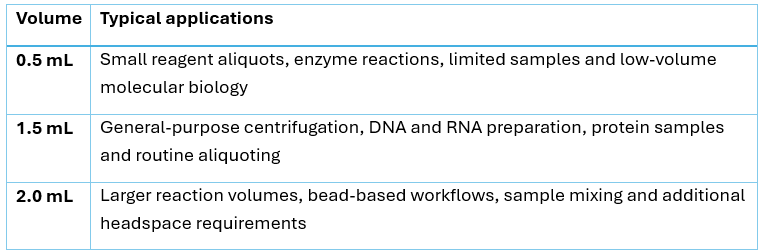
The correct size should provide sufficient working volume without forcing the tube to be filled to its maximum nominal capacity.
Adequate headspace is especially important when:
- Vortexing
- Heating
- Freezing
- Centrifuging
- Handling volatile liquids
- Mixing suspensions
- Using beads or solid particles
Good laboratory practices for tube use
To improve reproducibility :
1- Select the tube according to the required RCF and temperature.
2- Confirm whether the selected catalogue reference is sterile.
3- Verify DNase- and RNase-free status for molecular workflows.
4- Use amber tubes when the sample is light sensitive.
5- Choose low-retention formats for low-concentration or valuable analytes.
6- Match self-standing or conical designs to the handling procedure.
7- Confirm that the cap is fully closed before centrifugation.
8- Use a compatible rotor and rack.
9- Avoid exceeding the tube’s recommended working volume.
10- Test recovery under actual assay conditions when adsorption could affect quantitative results.
Frequently Asked Questions
What are screw-cap tubes used for?
=> Screw-cap tubes are used for sample storage, centrifugation, transportation and workflows where a secure seal is important. The threaded cap and O-ring help reduce leakage and evaporation.
What is the difference between a screw-cap tube and a microcentrifuge tube?
=> A screw-cap tube uses a threaded removable cap, generally with an O-ring. A conventional microcentrifuge tube normally uses an integral snap cap that opens more quickly during repetitive laboratory work.
What does DNase/RNase free mean?
=> It means the product has been tested to verify that detectable DNA-degrading and RNA-degrading enzyme activity is absent according to the manufacturer’s testing criteria.
Does DNase/RNase free mean sterile?
=> No. Nuclease-free status and sterility are separate specifications. A non-sterile tube can be DNase/RNase free, and sterility should always be confirmed for the exact product reference.
Why use a low-retention microcentrifuge tube?
=> A low-retention tube is intended to reduce the amount of liquid or analyte remaining on its inner surface. It can be beneficial for dilute, viscous, expensive or limited samples.
Are all low-retention tubes equally effective?
=> No. Recovery can depend on the tube material, analyte, concentration, buffer and contact time. Independent studies show that low-binding performance varies among products and experimental conditions.
What is the benefit of an amber tube?
=> Amber tubes reduce exposure to ultraviolet and visible light and are useful for samples or reagents that may degrade or change when exposed to light.
What is a self-standing tube?
=> A self-standing tube has a skirted or flattened base that allows it to remain upright without a rack.
What is a conical-bottom tube?
=> A conical-bottom tube tapers to a narrow point. This design can facilitate the concentration and recovery of pellets, precipitates or small residual volumes.
Which tube volume should I choose?
=> Use 0.5 mL for small-volume samples, 1.5 mL for routine laboratory preparation and 2.0 mL when more working volume or headspace is needed.
screw cap tubes
microcentrifuge tubes
polypropylene laboratory tubes
DNase RNase free tubes
sterile screw cap tubes
low-retention microcentrifuge tubes
sample storage tubes
EPDM O-ring tubes
self-standing tubes
conical tubes
amber laboratory tubes
1.5 mL microcentrifuge tubes
2 mL screw cap tubes
Published by Gentaur
15 Jul 2026
Recent Posts
14 Oct 2026Gentaur
cfDNA Extraction: Methods, Protocol, Sample Preparation, and Quality ControlIntroduction to cfDNA Extraction cfDNA extraction is the laboratory process used to isolate cell-free DNA (cfDNA) from biological samples, particularly blood plasma. This DNA consists of extracellular DNA fragments released into body fluids through c
08 Oct 2026Gentaur
Human Interleukin 6 ELISA Kit : Complete Guide to il 6 ELISA TestingInterleukin-6 (IL-6) is an important cytokine involved in immune regulation, inflammation, and cellular communication. Il 6 ELISA testing provides researchers with a practical method for detecting and quantifying human IL-6 in biological samples. A H
06 Oct 2026Gentaur
Automated Plasmid PurificationAutomated plasmid purification is becoming increasingly important in molecular biology laboratories that need to process larger numbers of samples while maintaining consistent DNA quality. Instead of relying entirely on manual centrifugation, pipetti
28 Sep 2026Gentaur
How to Interpret ELISA Results : A Practical Guide to OD Values, Standard Curves, Cutoffs and ControlsEnzyme-linked immunosorbent assay (ELISA) Enzyme-linked immunosorbent assay ( ELISA ) is widely used to detect and quantify proteins, antigens, antibodies, hormones, and other biological molecules. After completing an ELISA, the laboratory instrument