The science of Cryopreservation

Gentaur
10 Nov 2025
In modern cell and tissue research, the ability to reliably preserve biological material through freezing and thawing is absolutely critical. Whether working with stem cells, immune‐cells, tissue fragments or cell therapy candidates, an optimised cryopreservation medium is not a luxury, it's a cornerstone of experimental reproducibility and downstream functionality. The product CryoStor® CS10 is a ready-to-use, defined cryopreservation medium formulated with 10 % DMSO in a serum-free, animal component-free environment. According to the manufacturer, it is designed to support ultra-low temperature storage (−70 °C to −196 °C) of sensitive cells and tissues.
What's CryoStor® CS10 ?
Before focusing on the product, it is worth revisiting some of the underlying biology and physics of cryopreservation, this will help situate why a medium like CryoStor® CS10 matters.
-Physical and biological challenges
When cells (or tissues) are cooled to very low temperatures, multiple damaging events can occur. These include : ice‐crystal formation (both extracellular and intracellular), dehydration and solute‐concentration effects, mechanical stress, damage to membranes and cytoskeleton, osmotic shock, delayed‐onset cell death (apoptosis/necrosis post thaw) and metabolic/functional loss (NCBI, ResearchGate). For example, a University of California Davis guide states that cryoprotective agents (CPAs) such as DMSO help reduce intracellular ice and mitigate freezing injury.
-Role of cryoprotectants and medium formulation
Cryoprotective agents (CPAs) such as dimethyl sulfoxide (DMSO) (Wikipedia) are widely used because they penetrate cells, reduce ice nucleation, decrease freezing‐point, moderate osmotic changes and help maintain membrane integrity during freeze/thaw. For many mammalian cells, ~10 % DMSO is a standard benchmark.


However, CPA alone is not enough, the surrounding medium (salt concentrations, pH, buffering, de‐ionised water, absence of animal components or serum if one wants defined conditions) and the cooling/thawing protocol matter a great deal. That is why commercial cryopreservation media (such as CryoStor® CS10) are formulated to address multiple parameters: they are serum‐free, animal‐component free (to reduce variability and risk of xenogenic/animal derived contamination), cGMP or USP grade, sterility tested, endotoxin controlled. According to manufacturer literature, CryoStor® CS10 also aims to reduce “Cryopreservation‐Induced Delayed‐Onset Cell Death” (CIDOD) by modulating biochemical responses to the stress of freezing. NCBI
-Freezing rates, thawing rates and functional recovery
As many standard protocols emphasise, the rate of cooling (typically −1 °C to −3 °C per minute for many cell lines) and a rapid thaw (for example, ~37 °C water bath) are important for optimal results.
The goal is to avoid intracellular ice formation (which is almost always lethal) and minimise extracellular ice damage/solution effects. Choosing a well-formulated freezing medium helps support these biophysical requirements by providing the appropriate cryoprotectant concentration and osmotic buffering.
The upshot: when the foundation is strong (cell health pre-freeze, defined medium, optimised CPA, controlled cooling/freezing, rapid thaw and appropriate post-thaw handling), then high viability and sustained functionality post‐thaw become feasible even for very sensitive cell types (e.g., pluripotent stem cells, tissue fragments). This sets the stage for why CryoStor® CS10 is of interest.
Introducing CryoStor® CS10: specifications, features & benefits
Here we dig into what this medium offers, based on product literature, and how it compares to a typical freezing medium.
Key specifications
From the manufacturer’s product information sheet :
- It is a ready-to-use cryopreservation medium : no need to add additional DMSO or serum/albumin.
- Contains 10 % DMSO (v/v) as the cryoprotectant.
- Serum-free, protein-free, and animal component-free, defined formulation.
- Manufactured under cGMP or with USP grade components, sterility and endotoxin tested.
- Suitable storage : 2-8 °C before use, protected from light (until the expiry date).
- Designed for freezing cells and tissues at ultra‐low temps (e.g., −80 °C to −196 °C) including liquid nitrogen vapor.
- Suitable for a range of cell types : human, mouse, rat, non‐human primate; cell types include hematopoietic stem & progenitor cells, mesenchymal stem cells (MSCs), myeloma lines, hybridomas, blood‐derived immune cells, pluripotent stem cells etc.
Practical benefits for researchers
- The “defined” and animal-component free nature reduces lot‐to‐lot variability and reduces risk of xenogeneic contamination (important for translational/clinical research).
- The 10 % DMSO formulation reflects the standard benchmark for many mammalian cell types, so minimal adjustment is needed.
- Eliminates the need to prepare freezing medium manually (mixing basal medium + DMSO + serum/albumin), saving time, reducing error, improving reproducibility.
- Demonstrated high post-thaw viability and retention of functional capacity for sensitive cells (see next section).
- Compatible with regulatory workflows (cGMP manufacture, USP grade), relevant if your research is translational or heading toward clinical applications.
Maxanim : CryoStor® CS10
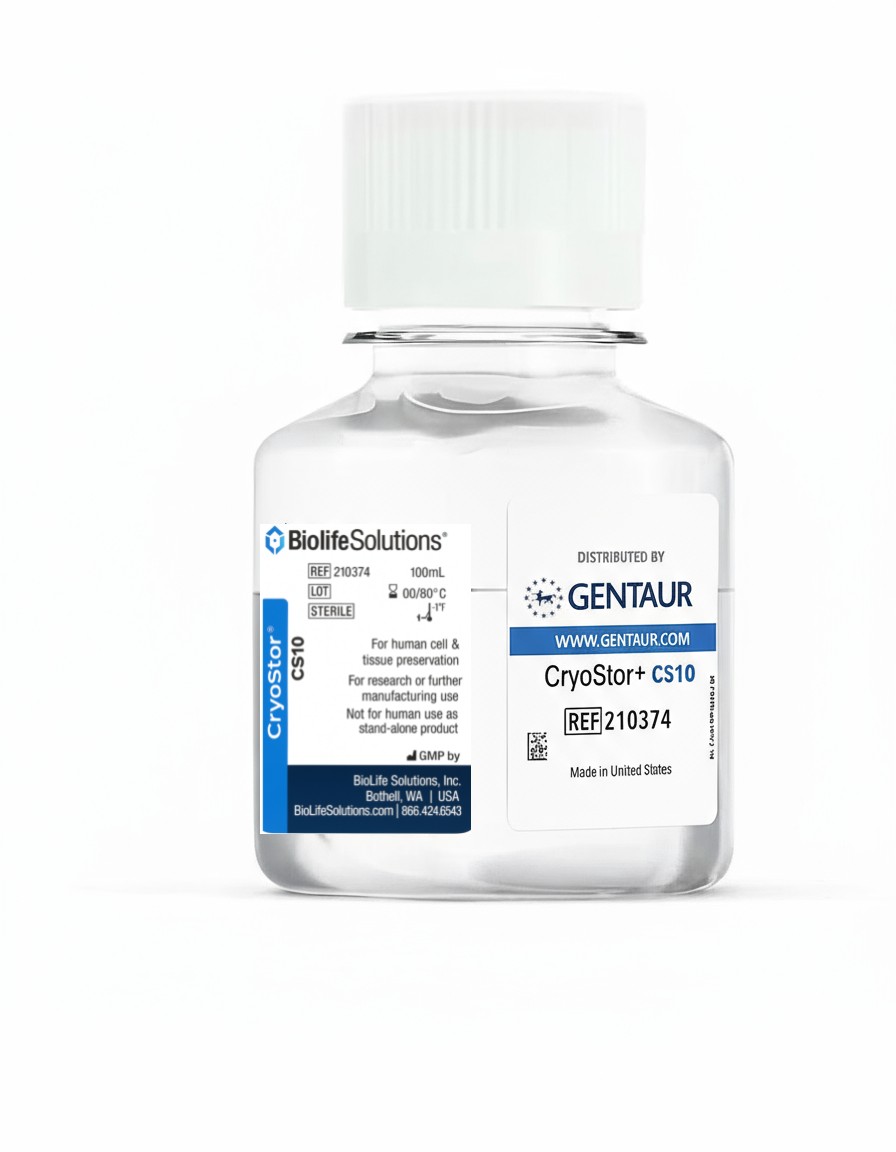
CryoStor® CS10
Cryopreservation
CPAs
10 % DMSO
Cryopreservation Medium
Published by Gentaur
10 Nov 2025
Recent Posts
14 Oct 2026Gentaur
cfDNA Extraction: Methods, Protocol, Sample Preparation, and Quality ControlIntroduction to cfDNA Extraction cfDNA extraction is the laboratory process used to isolate cell-free DNA (cfDNA) from biological samples, particularly blood plasma. This DNA consists of extracellular DNA fragments released into body fluids through c
08 Oct 2026Gentaur
Human Interleukin 6 ELISA Kit : Complete Guide to il 6 ELISA TestingInterleukin-6 (IL-6) is an important cytokine involved in immune regulation, inflammation, and cellular communication. Il 6 ELISA testing provides researchers with a practical method for detecting and quantifying human IL-6 in biological samples. A H
06 Oct 2026Gentaur
Automated Plasmid PurificationAutomated plasmid purification is becoming increasingly important in molecular biology laboratories that need to process larger numbers of samples while maintaining consistent DNA quality. Instead of relying entirely on manual centrifugation, pipetti
28 Sep 2026Gentaur
How to Interpret ELISA Results : A Practical Guide to OD Values, Standard Curves, Cutoffs and ControlsEnzyme-linked immunosorbent assay (ELISA) Enzyme-linked immunosorbent assay ( ELISA ) is widely used to detect and quantify proteins, antigens, antibodies, hormones, and other biological molecules. After completing an ELISA, the laboratory instrument