Understanding MMDx: The Molecular Microscope Diagnostic System Transforming Kidney Transplant Care

Gentaur
28 Jan 2026
"Discover MMDx, the Molecular Microscope Diagnostic System revolutionizing kidney transplant care. Learn how molecular analysis detects rejection, guides treatment, and predicts graft outcomes."
Understanding MMDx: The Molecular Microscope Diagnostic System Transforming Kidney Transplant Care
Kidney transplants are life-saving, but monitoring their health is a complex challenge. Traditional biopsy methods often rely on subjective histology, which can miss early signs of rejection or injury. Enter MMDx, the Molecular Microscope Diagnostic System, a revolutionary technology that uses gene expression to decode the molecular phenotype of kidney transplants.
In this blog, we’ll explore what MMDx is, how it works, and why it’s becoming the gold standard in transplant diagnostics.
Related products
KIDNEY
Catalog number: GTR03813908Rat KIDNEY
Catalog number: GTR03938040Human Kidney
Catalog number: GTR02309384Kidney, Rabbit
Catalog number: GTR11413053Kidney Lysate
Catalog number: GTR03732750Dog Kidney RNA
Catalog number: GTR00993949Cat Kidney cDNA
Catalog number: GTR00993398Dog Kidney cDNA
Catalog number: GTR00994041Pig Kidney cDNA
Catalog number: GTR00994302kidney (MDBK) cells
Catalog number: GTR05663891cDNA - Lupus: Kidney
Catalog number: GTR00904170Human Kidney CAFs
Catalog number: GTR01065513What is MMDx?
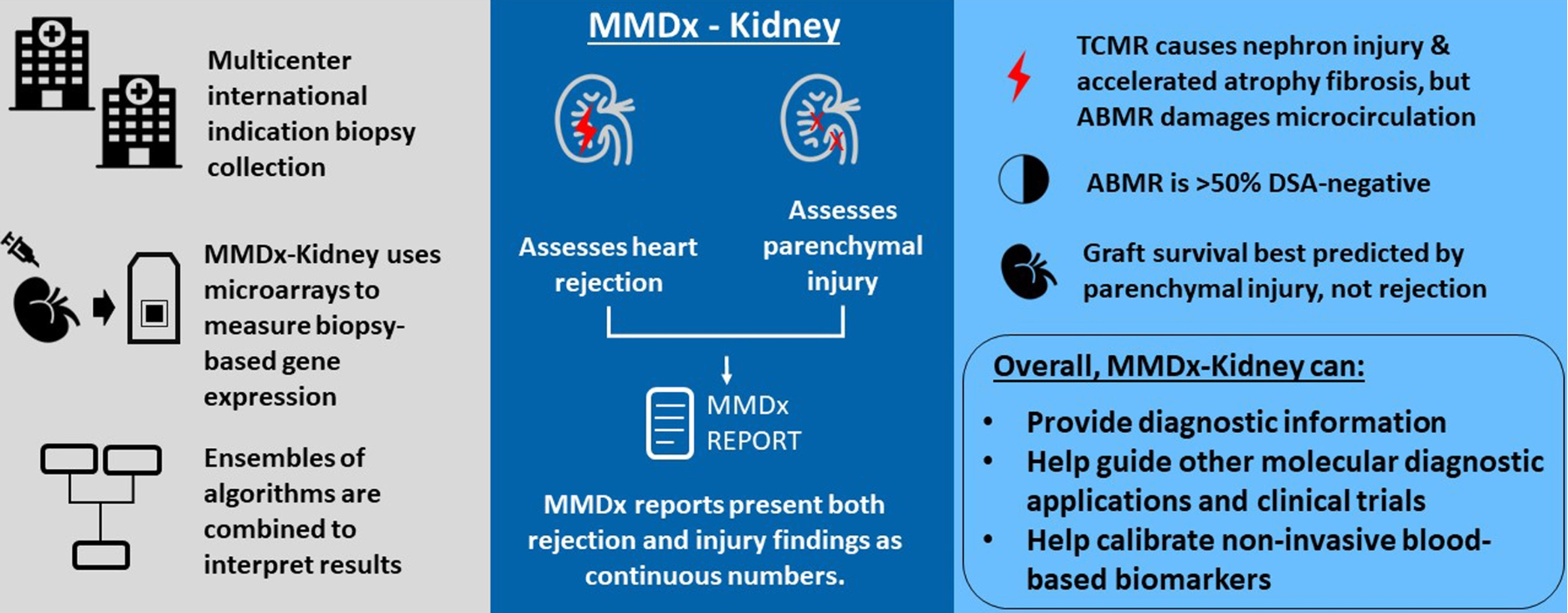
MMDx is a machine-learning-based diagnostic platform that evaluates kidney transplant biopsies at the molecular level. Instead of relying solely on visual examination of tissue under a microscope, MMDx measures the expression of thousands of genes to detect patterns associated with:
- T Cell–Mediated Rejection (TCMR)
- Antibody-Mediated Rejection (AMR)
- Acute Kidney Injury (AKI)
- Chronic injury or fibrosis
By analyzing the molecular “fingerprint” of a biopsy, MMDx provides a precise, reproducible, and objective assessment of the transplant’s health.
How Does MMDx Work?
MMDx combines advanced genomics and machine learning to generate actionable insights:
- Gene Expression Profiling
- A biopsy sample is analyzed using microarrays to measure the expression of thousands of genes simultaneously.
- Reference Comparison
- The molecular profile is compared against a large database of known transplant injury signatures. This database includes biopsies with confirmed rejection, injury, or healthy outcomes.
- Molecular Classifiers
- MMDx generates classifier scores that quantify the probability of TCMR, AMR, or other injuries. These scores guide clinicians in diagnosis and treatment planning.
- Integrated Interpretation
- The results are combined with clinical data, including kidney function tests and serology, providing a holistic view of graft health.
Why MMDx is a Game-Changer in Kidney Transplant Care
1. Early and Accurate Detection of Rejection
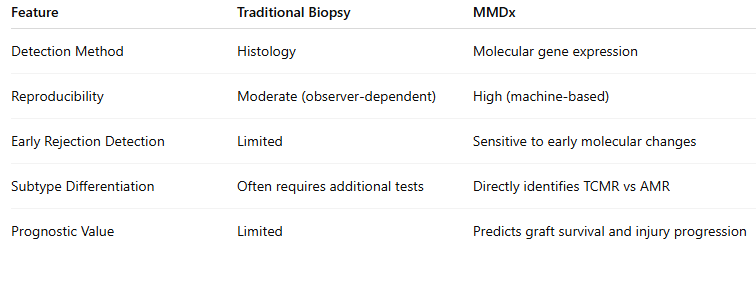
Traditional biopsies can sometimes miss subtle or early signs of rejection. MMDx detects molecular changes before visible tissue damage occurs, allowing for timely intervention.
2. Objective and Reproducible
Unlike histology, which can vary depending on the pathologist’s experience, MMDx provides standardized, machine-based results. This reduces diagnostic ambiguity.
3. Differentiates TCMR and AMR
MMDx distinguishes between T Cell–Mediated Rejection and Antibody-Mediated Rejection, even in cases where C4d staining or donor-specific antibodies are negative. This is crucial for selecting the right treatment strategy.
4. Predicts Long-Term Graft Outcomes
Molecular patterns of injury detected by MMDx correlate with future graft function, helping clinicians anticipate complications and personalize immunosuppressive therapy.
MMDx vs Traditional Biopsy
Real-World Applications of MMDx
MMDx is currently used in clinical transplant centers worldwide. Its applications include:
- Guiding immunosuppressive therapy to prevent over- or under-treatment
- Clarifying ambiguous biopsy results (“borderline rejection”)
- Monitoring patients longitudinally to detect subclinical injury
- Researching transplant biology and identifying novel therapeutic targets
The Future of MMDx
As genomic technologies and artificial intelligence advance, MMDx is likely to become even more integrated into routine clinical practice. Future developments may include:
- Non-invasive molecular diagnostics using blood-based biomarkers calibrated against MMDx
- Personalized immunosuppression plans guided by molecular injury scores
- Integration with AI-driven predictive models for transplant outcomes
Conclusion
MMDx represents a paradigm shift in kidney transplant care, offering precision, objectivity, and predictive power that traditional methods cannot match. By detecting early molecular changes, differentiating rejection types, and forecasting graft outcomes, MMDx empowers clinicians to make data-driven decisions that improve patient survival and quality of life.
For anyone involved in kidney transplantation, staying updated on MMDx technology is no longer optional it’s essential.
Reference
Halloran, P. F., Madill-Thomsen, K. S., & Reeve, J. (2024). The molecular phenotype of kidney transplants: Insights from the development of the Molecular Microscope Diagnostic System (MMDx). Transplantation, 108(1), 45–71. https://journals.lww.com/transplantjournal/fulltext/2024/01000/the_molecular_phenotype_of_kidney_transplants_.12.aspx
mmdx
transplantation
Published by Gentaur
28 Jan 2026
Recent Posts
14 Oct 2026Gentaur
cfDNA Extraction: Methods, Protocol, Sample Preparation, and Quality ControlIntroduction to cfDNA Extraction cfDNA extraction is the laboratory process used to isolate cell-free DNA (cfDNA) from biological samples, particularly blood plasma. This DNA consists of extracellular DNA fragments released into body fluids through c
08 Oct 2026Gentaur
Human Interleukin 6 ELISA Kit : Complete Guide to il 6 ELISA TestingInterleukin-6 (IL-6) is an important cytokine involved in immune regulation, inflammation, and cellular communication. Il 6 ELISA testing provides researchers with a practical method for detecting and quantifying human IL-6 in biological samples. A H
06 Oct 2026Gentaur
Automated Plasmid PurificationAutomated plasmid purification is becoming increasingly important in molecular biology laboratories that need to process larger numbers of samples while maintaining consistent DNA quality. Instead of relying entirely on manual centrifugation, pipetti
28 Sep 2026Gentaur
How to Interpret ELISA Results : A Practical Guide to OD Values, Standard Curves, Cutoffs and ControlsEnzyme-linked immunosorbent assay (ELISA) Enzyme-linked immunosorbent assay ( ELISA ) is widely used to detect and quantify proteins, antigens, antibodies, hormones, and other biological molecules. After completing an ELISA, the laboratory instrument