Understanding Skin Cell Lines : A Technical Overview for Experts

Gentaur
19 Aug 2025
The skin is a multifaceted organ comprising primarily keratinocytes and fibroblasts, each pivotal to modeling human dermatological physiology and disease in vitro. Below, I explore the most widely used skin cell lines—HaCaT keratinocytes and dermal fibroblasts—highlighting culture behaviors, applications, and foundational research references.
Keratinocyte Cell Lines — HaCaT and Beyond
HaCaT cells are a spontaneously immortalized, aneuploid human keratinocyte line, noted for retaining differentiation potential in vitro—making them a reliable proxy for human skin studies. They have been leveraged in diverse experimental contexts :
- Infection models : HaCaT cells serve as a robust “skin substrate” to study microbial colonization dynamics involving S. epidermidis, S. aureus, P. aeruginosa, and more. (more)
- Immune modulation : Upon stimulation with sensitizers or irritants, HaCaT cells significantly upregulate interleukin‑8 (IL‑8) expression—a key inflammatory marker.
- UVB response & microvesicle release : Exposure to UVB radiation triggers the release of keratinocyte-derived microvesicle particles (MVPs) that mediate systemic signaling—highlighting HaCaT’s utility in photobiology.
- Receptor signaling studies : Experiments manipulating CXCR4 and cytokines (e.g., IL-22) in HaCaT cells elucidate pathways relevant to epidermal proliferation and inflammatory regulation.
Researchers have used HaCaT cells to explore transfection-based oncogenic transformation—for instance, PDGF-B expression increased fibroblast proliferation and drove tumorigenicity in mouse models.
Dermal Fibroblast Cell Models
Dermal fibroblasts play a structural and dynamic role in the dermis, synthesizing extracellular matrix components like collagen, laminin, and fibronectin that support wound healing and skin architecture.
These cells have been employed to :
- Validate scaffolds and regenerative strategies for burn healing by restoring extracellular matrix using fibrin sealants and collagen constructs (see University College London research).
- Facilitate iPSC development : Harvard Stem Cell researchers have reprogrammed fibroblasts into pluripotent states—correcting genetic disorders via homologous recombination in vivo.
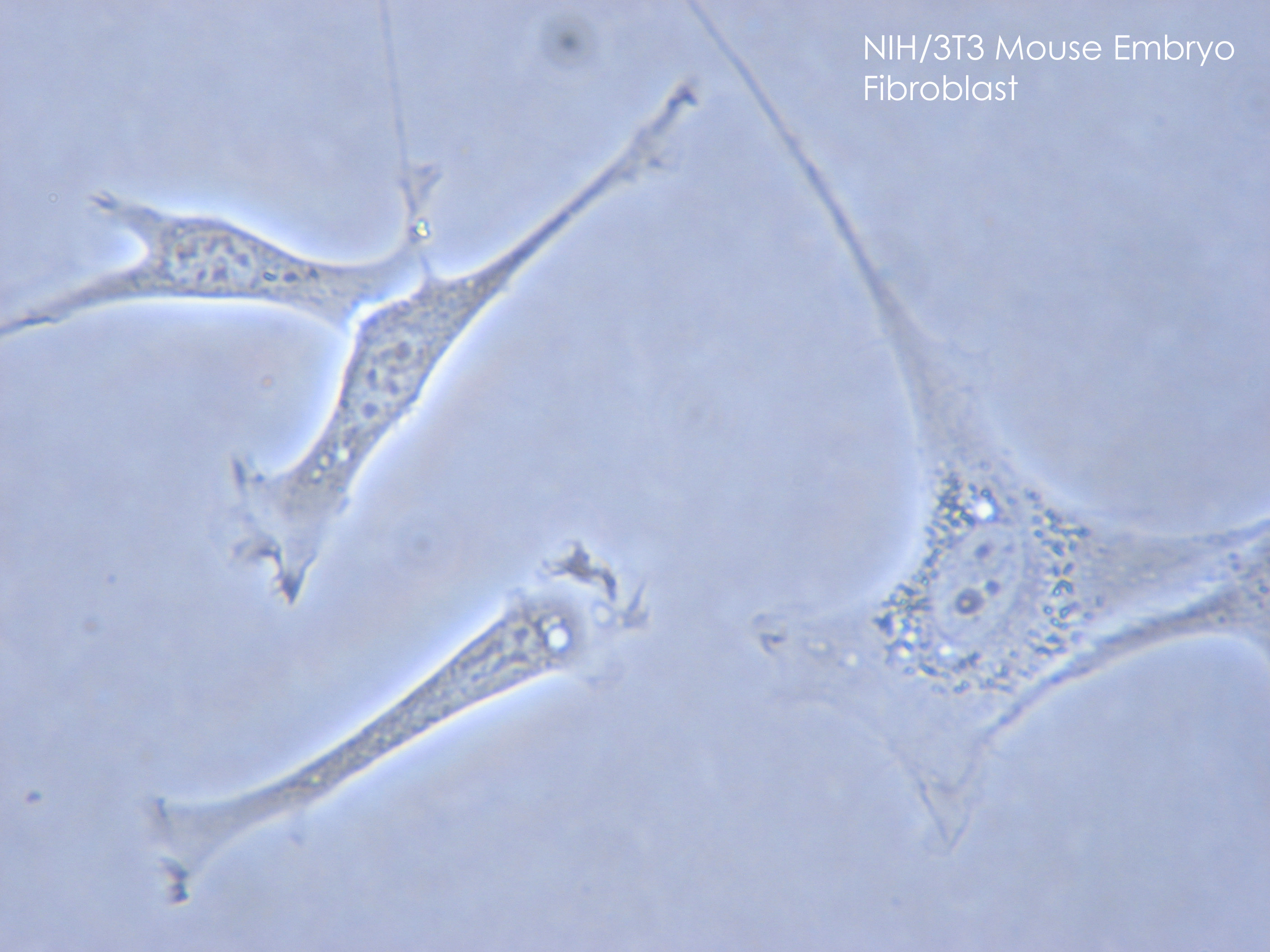
Classic fibroblast lines like NIH‑3T3—mouse embryonic fibroblasts—have served as feeder layers for keratinocyte cultures since the 1970s, establishing a foundational basis for skin model development.
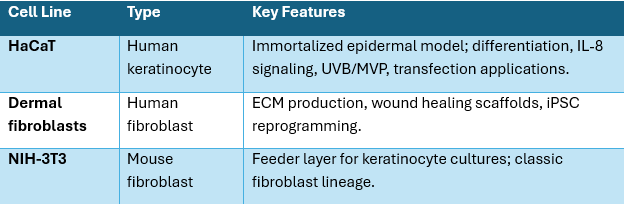
Commonly Used Skin Cell Lines (Summary Table)
Applications Across Research Domains
- Skin barrier & infection studies : HaCaT is central to modeling pathogen-keratinocyte-microbiome interactions (e.g., S. aureus, P. aeruginosa).
- Inflammatory modulation : IL‑8 dynamics in response to irritants/antigens (e.g., contact hypersensitivity models).
- Photobiology and immunosuppression : UVB-induced MVPs and systemic signaling through PAFR and CaSR pathways.
- Cancer and transformation : PDGF-B’s role in promoting fibroblast proliferation and tumor formation in HaCaT derivatives.
- Wound regeneration : Strategies combining fibroblast scaffolds and growth factors for dermal repair; harnessing ECM dynamics.
- Stem cell biology : Dermal fibroblast utility as reprogramming substrates for iPSC generation.
Keratinocyte Cell Lines
HaCaT
Keratinocyte
Dermal Fibroblast
iPSC development
Stem cell biology
NIH‑3T3—mouse embryonic fibroblasts
Published by Gentaur
19 Aug 2025
Recent Posts
14 Oct 2026Gentaur
cfDNA Extraction: Methods, Protocol, Sample Preparation, and Quality ControlIntroduction to cfDNA Extraction cfDNA extraction is the laboratory process used to isolate cell-free DNA (cfDNA) from biological samples, particularly blood plasma. This DNA consists of extracellular DNA fragments released into body fluids through c
08 Oct 2026Gentaur
Human Interleukin 6 ELISA Kit : Complete Guide to il 6 ELISA TestingInterleukin-6 (IL-6) is an important cytokine involved in immune regulation, inflammation, and cellular communication. Il 6 ELISA testing provides researchers with a practical method for detecting and quantifying human IL-6 in biological samples. A H
06 Oct 2026Gentaur
Automated Plasmid PurificationAutomated plasmid purification is becoming increasingly important in molecular biology laboratories that need to process larger numbers of samples while maintaining consistent DNA quality. Instead of relying entirely on manual centrifugation, pipetti
28 Sep 2026Gentaur
How to Interpret ELISA Results : A Practical Guide to OD Values, Standard Curves, Cutoffs and ControlsEnzyme-linked immunosorbent assay (ELISA) Enzyme-linked immunosorbent assay ( ELISA ) is widely used to detect and quantify proteins, antigens, antibodies, hormones, and other biological molecules. After completing an ELISA, the laboratory instrument