Unlocking the Power of NTRK1: A Deep Dive into TRKA and Its Scientific Importance

Gentaur
18 Sep 2025
In the ever-evolving world of biomedical research, certain molecules stand out not only for their biological significance but also for their potential in clinical applications. One such molecule is NTRK1 (Neurotrophic Tyrosine Kinase Receptor Type 1), more commonly known as TRKA. This receptor, a high-affinity nerve growth factor receptor, has become a focal point of interest in neuroscience, oncology, and drug development.
In this article, we will explore the biology of NTRK1, its diverse roles in human physiology, its implications in disease, and how researchers can leverage advanced tools—such as the NTRK1 product from Gentaur—to accelerate discoveries in the lab.
What is NTRK1?
What is NTRK1?
NTRK1, also known by many aliases—MTC, TRK, TRKA, High affinity nerve growth factor receptor, TRK1-transforming tyrosine kinase protein, Tropomyosin-related kinase A, Tyrosine kinase receptor, Tyrosine kinase receptor A, gp140trk—is a receptor tyrosine kinase that plays a critical role in neuronal growth and survival.
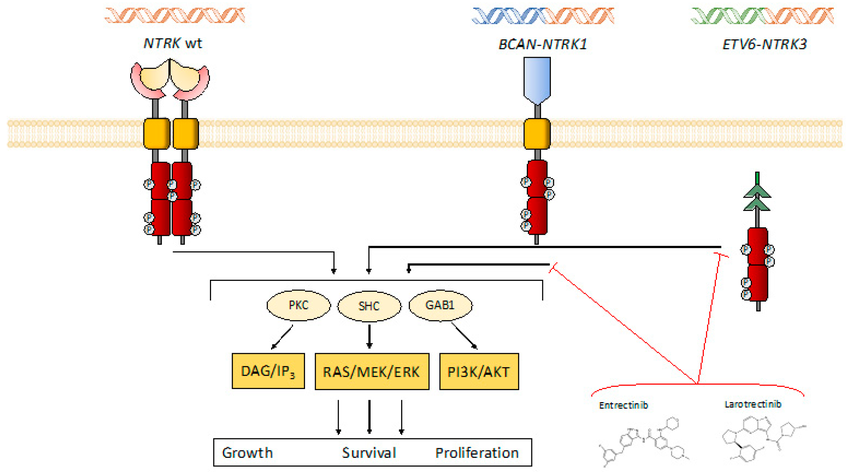
When its ligand, nerve growth factor (NGF), binds to NTRK1, the receptor undergoes dimerization and autophosphorylation, triggering downstream signaling pathways including MAPK/ERK, PI3K/AKT, and PLCγ. These pathways influence cell survival, differentiation, synaptic plasticity, and growth of nerve fibers.
Roles of NTRK1 in Health
- Neurodevelopment: Essential for the maturation of sensory neurons and the development of the peripheral nervous system.
- Maintenance of Neuron Function: Supports neuronal survival, synaptic maintenance, and plasticity in the mature nervous system.
- Pain Sensation: Because NTRK1 is a receptor for NGF, it is involved in pain modulation—making it a target of interest in pain disorders.
- Disorders from Mutation: Mutations in NTRK1 can cause conditions such as Congenital Insensitivity to Pain with Anhidrosis (CIPA), affecting pain perception and sweat production.
NTRK1 and Cancer
One of the most exciting areas where NTRK1 has clinical importance is in the field of oncology:
- NTRK1 Gene Fusions: When NTRK1 becomes fused with other genes, the resulting fusion proteins can drive tumor growth by constitutively activating the receptor.
- Therapeutic Targeting: TRK inhibitors such as larotrectinib and entrectinib have been developed to target NTRK fusion-positive tumors and have shown remarkable results.
- Cancers Involved: These fusions have been discovered in a variety of tumors, including thyroid cancer, lung cancer, pediatric sarcomas, and gliomas.
Importance in Neuroscience and Beyond
Beyond cancer, NTRK1 is central in research on:
- Neurodegenerative diseases: Alzheimer’s, Parkinson’s, and others where NGF/NTRK1 signaling might be disrupted.
- Regeneration after injury: Stimulating NTRK1 signaling may promote neuronal repair.
- Pain management: Because of its role in NGF signaling, blocking or modulating NTRK1 is under investigation for new analgesic approaches.
Gentaur’s NTRK1 Product — A Researcher’s Tool
For scientists studying NTRK1—whether in the context of neural development, disease, or cancer—having reliable, specific, and validated reagents is essential. That’s where Gentaur’s NTRK1 product comes into play.
The product is available here:
Gentaur NTRK1 product page

Why Use Gentaur’s NTRK1 Product?
- High specificity and validation: Ensures that your results are reliable.
- Multiple applications: Can be used in Western blotting, immunohistochemistry, flow cytometry, functional assays, etc.
- Supporting reproducible science: Having a reagent you can trust minimizes experimental variation.
Future Directions and Research Opportunities
- Targeted cancer therapy refinements: Better inhibitors to overcome resistance, combination treatments.
- Biomarker discovery: Early detection of NTRK1 fusions in tumors.
- Neuroprotective strategies: Using NGF/NTRK1 signaling to protect or restore neurons in degenerative diseases.
- Pain modulation advances: Developing more specific modulators of TRKA to treat chronic pain with fewer side effects.
Conclusion
NTRK1 (TRKA) stands at the intersection of neurobiology and oncology—instrumental in normal neuron function, yet implicated in serious disease when dysregulated. Its importance in pain signaling, cancer, neural development, and regeneration makes it a critical focus of research.
Having a reliable and specific product like Gentaur’s NTRK1 (TRKA) reagent is an invaluable asset for any lab delving into this field. By using well-validated tools, researchers can push forward with confidence, generate robust data, and ultimately translate insights into therapies.
If you’re working on projects related to NTRK1—be it in cancer biology, nervous system research, or beyond—consider incorporating Gentaur’s NTRK1 reagent into your workflow. It could make a difference in reliability, precision, and impact.
If you like, I can also generate a version of this blog optimized for academic readers (with more references) or a shorter version for social media. Would you prefer that?
Biology
MedicalBiology
Immunology
CellBiology
MolecularBiology
Published by Gentaur
18 Sep 2025
Recent Posts
14 Oct 2026Gentaur
cfDNA Extraction: Methods, Protocol, Sample Preparation, and Quality ControlIntroduction to cfDNA Extraction cfDNA extraction is the laboratory process used to isolate cell-free DNA (cfDNA) from biological samples, particularly blood plasma. This DNA consists of extracellular DNA fragments released into body fluids through c
08 Oct 2026Gentaur
Human Interleukin 6 ELISA Kit : Complete Guide to il 6 ELISA TestingInterleukin-6 (IL-6) is an important cytokine involved in immune regulation, inflammation, and cellular communication. Il 6 ELISA testing provides researchers with a practical method for detecting and quantifying human IL-6 in biological samples. A H
06 Oct 2026Gentaur
Automated Plasmid PurificationAutomated plasmid purification is becoming increasingly important in molecular biology laboratories that need to process larger numbers of samples while maintaining consistent DNA quality. Instead of relying entirely on manual centrifugation, pipetti
28 Sep 2026Gentaur
How to Interpret ELISA Results : A Practical Guide to OD Values, Standard Curves, Cutoffs and ControlsEnzyme-linked immunosorbent assay (ELISA) Enzyme-linked immunosorbent assay ( ELISA ) is widely used to detect and quantify proteins, antigens, antibodies, hormones, and other biological molecules. After completing an ELISA, the laboratory instrument