What Is an ELISA Kit? Complete Guide for Researchers

Gentaur
22 Apr 2026
Learn what an ELISA kit is, how it works, the main ELISA types, common applications, and how to choose the right kit for your research.
What Is an ELISA Kit? Complete Guide for Researchers
ELISA stands for Enzyme-Linked Immunosorbent Assay. An ELISA kit is a laboratory tool used to detect and measure specific molecules in a sample, usually proteins, antibodies, hormones, cytokines, or antigens.
Researchers use ELISA kits because they are :
- sensitive
- relatively easy to use
- suitable for many sample types
- useful for both research and diagnostic workflows
In simple terms, an ELISA kit helps answer this question : “Is my target molecule present, and how much of it is in the sample?”.
What does an ELISA kit measure?
An ELISA kit can measure many biological targets, including :
- cytokines
- growth factors
- antibodies
- viral antigens
- biomarkers
- hormones
- inflammatory proteins
For example, a researcher may use an ELISA kit to measure :
- IL-6 in serum
- TNF-alpha in plasma
- IgG antibodies in blood
- a disease biomarker in cell culture supernatant.
This makes ELISA one of the most widely used techniques in immunology, cell biology, microbiology, and translational research.
How does an ELISA kit work?
ELISA works through a specific binding reaction between an antibody and its target.
The basic process is :
1- A target molecule in the sample binds to an antibody.
2- A second antibody linked to an enzyme helps detect that binding.
3- A substrate is added.
4- The enzyme reacts with the substrate and creates a color signal.
5- The signal intensity is measured and related to the amount of target present.
The stronger the signal, the higher the amount of target analyte in the sample.
Main components of an ELISA kit
Most ELISA kits include :
- pre-coated microplate
- capture antibody or antigen
- detection antibody
- enzyme conjugate
- standards
- assay buffer
- wash buffer
- substrate solution
- stop solution
- protocol instructions
Some kits are ready to use, while others require more preparation.
Types of ELISA kits
There are several ELISA formats, and each serves a different purpose.
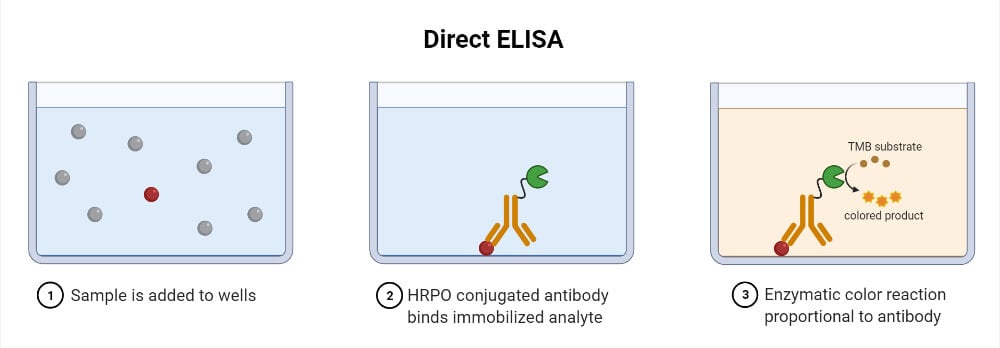
1. Direct ELISA
In direct ELISA, a labeled antibody binds directly to the target antigen.
Advantages :
- fast.
- fewer steps
Limitations :
- lower sensitivity in some cases.
- less flexibility.
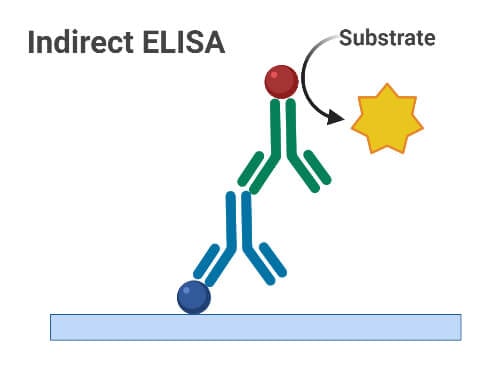
2. Indirect ELISA
In indirect ELISA, the target is first bound by a primary antibody, then detected by a labeled secondary antibody.
Advantages :
- more flexible.
- can improve signal.
Limitations :
- more steps.
- possible background signal.
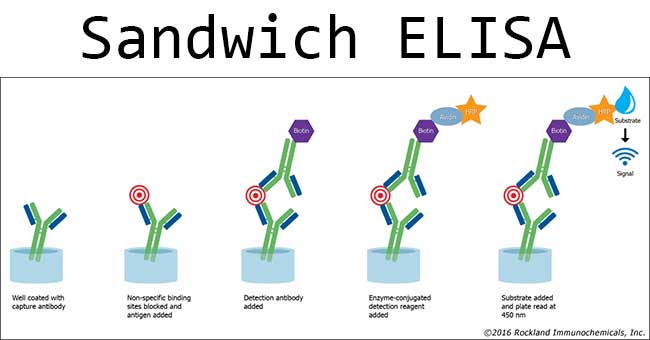
3. Sandwich ELISA
This is one of the most common formats for protein detection. The target is captured between two antibodies.
Advantages :
- high specificity
- high sensitivity
- ideal for complex samples
Limitations :
- requires matched antibody pairs
- can be more expensive
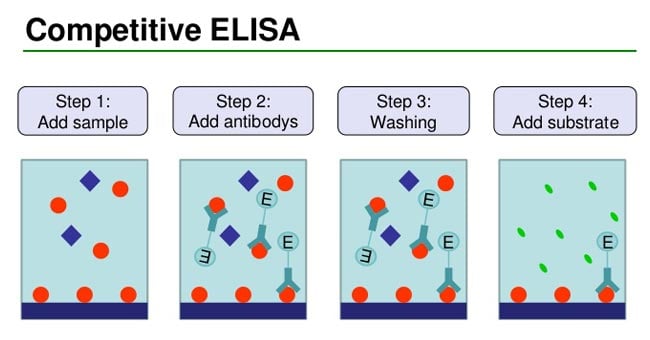
4. Competitive ELISA
In competitive ELISA, the sample target competes with a labeled target for binding sites.
Advantages :
- useful for small molecules
- good when the target has only one antibody binding site
Limitations :
- more difficult to interpret
- often less intuitive for beginners
Why researchers use ELISA kits?
ELISA kits remain popular because they offer a strong balance between performance and convenience.
Key benefits :
- quantitative or semi-quantitative results.
- good sensitivity.
- strong specificity.
- relatively simple workflow.
- suitable for many sample types.
- scalable for multiple samples.
They are especially useful when researchers need to compare levels of a target across experimental groups.
Common applications of ELISA kits
ELISA kits are used in many research areas.
Immunology :
- cytokine quantification.
- inflammation studies.
- immune response analysis.
Infectious disease research :
- antigen detection.
- antibody response measurement.
Cancer research
- biomarker monitoring.
- signaling protein analysis.
Cell biology :
- secreted protein measurement.
- pathway studies.
Neuroscience :
- neuroinflammatory markers.
- disease-associated proteins.
Food and environmental testing :
- allergen detection.
- toxin analysis.
- contaminant monitoring.
Sample types used in ELISA
Depending on the kit, common sample types include :
- serum
- plasma
- cell culture supernatant
- tissue lysates
- urine
- saliva
- other biological fluids
It is important to use the sample types validated for the specific kit. Using the wrong matrix can affect accuracy and reproducibility.
How to choose the right ELISA kit?
Choosing the right ELISA kit is critical. A poor choice can lead to weak signals, high background, or unreliable data.
1. Define your target clearly
Know exactly what you want to detect:
- protein name
- species
- isoform if relevant
- antigen or antibody
2. Check species reactivity
Make sure the kit matches your sample species:
- human
- mouse
- rat
- rabbit
- other species
3. Review sample compatibility
Confirm that the kit supports your sample type:
- serum
- plasma
- lysate
supernatant
4. Look at sensitivity range
- Make sure the assay detection range matches the expected concentration of your target.
5. Evaluate specificity
- Check whether the kit cross-reacts with related proteins.
6. Review assay time and protocol complexity
- Some labs prefer shorter workflows. Others prioritize sensitivity over speed.
7. Consider reproducibility
Look for information on:
- intra-assay precision
- inter-assay precision
- validation data
8. Check storage and stability
- Make sure the kit fits your lab’s storage conditions and workflow timing.
ELISA kit workflow: step by step
A typical ELISA protocol looks like this :
1- Prepare standards and samples.
2- Add standards and samples to the plate.
3- Incubate for binding.
4- Wash to remove unbound material.
5- Add detection antibody.
6- Incubate again
7- Wash
8- Add enzyme conjugate if required
9- Add substrate
10- Wait for color development
11- Add stop solution
12- Read absorbance with a plate reader
13- Calculate concentration using the standard curve
Exact steps vary by kit, so the manufacturer protocol should always be followed.
Common ELISA problems and troubleshooting
Even good kits can fail if the workflow is not optimized.
Weak or no signal
Possible causes :
- target concentration too low
- incorrect reagent preparation
- expired reagents
- insufficient incubation time
- incorrect storage
High background
Possible causes :
- inadequate washing
- contaminated reagents
- too much detection antibody
- non-specific binding
Poor standard curve
Possible causes:
- pipetting errors
- improper dilution
- plate reader issues
- incorrect mixing of standards
High variability between replicates
Possible causes:
- inconsistent pipetting
- edge effects
- uneven washing
- timing differences across wells
ELISA vs other protein detection methods
Researchers often compare ELISA with other assays.
ELISA vs Western blot
- ELISA is usually better for quantification
- Western blot is better for protein size confirmation
ELISA vs PCR
- ELISA measures proteins or antibodies
- PCR measures nucleic acids
ELISA vs multiplex assays
- ELISA often focuses on one target at a time
- multiplex assays can measure several targets in one run
Each method has its role depending on the research goal.
Best practices for reliable ELISA results
To improve accuracy and reproducibility :
- follow the protocol exactly
- run standards carefully
- include controls
- avoid repeated freeze-thaw cycles
- use calibrated pipettes
- wash thoroughly
- analyze samples in duplicates or triplicates when possible
Small technique errors can strongly affect results.
Conclusion
An ELISA kit is one of the most practical tools for detecting and measuring biological targets in research samples. It combines specificity, sensitivity, and relative ease of use, which is why it remains a standard method across many life science fields.
The key to success is not just choosing any kit, but choosing the right kit for the right target, sample type, and application.
For researchers working with cytokines, biomarkers, antibodies, or other proteins, ELISA remains a dependable and efficient solution.
CTA section for Gentaur
Looking for the right ELISA kit for your research?
Browse Gentaur’s ELISA kit solutions by target, species, and application to find the best fit for your workflow.
what is an ELISA kit
how does ELISA work
what is an ELISA kit used for
how does an ELISA kit work step by step
ELISA test kit
ELISA protocol
types of ELISA
Published by Gentaur
22 Apr 2026
Recent Posts
14 Oct 2026Gentaur
cfDNA Extraction: Methods, Protocol, Sample Preparation, and Quality ControlIntroduction to cfDNA Extraction cfDNA extraction is the laboratory process used to isolate cell-free DNA (cfDNA) from biological samples, particularly blood plasma. This DNA consists of extracellular DNA fragments released into body fluids through c
08 Oct 2026Gentaur
Human Interleukin 6 ELISA Kit : Complete Guide to il 6 ELISA TestingInterleukin-6 (IL-6) is an important cytokine involved in immune regulation, inflammation, and cellular communication. Il 6 ELISA testing provides researchers with a practical method for detecting and quantifying human IL-6 in biological samples. A H
06 Oct 2026Gentaur
Automated Plasmid PurificationAutomated plasmid purification is becoming increasingly important in molecular biology laboratories that need to process larger numbers of samples while maintaining consistent DNA quality. Instead of relying entirely on manual centrifugation, pipetti
28 Sep 2026Gentaur
How to Interpret ELISA Results : A Practical Guide to OD Values, Standard Curves, Cutoffs and ControlsEnzyme-linked immunosorbent assay (ELISA) Enzyme-linked immunosorbent assay ( ELISA ) is widely used to detect and quantify proteins, antigens, antibodies, hormones, and other biological molecules. After completing an ELISA, the laboratory instrument